
Vande Bharat vs Other Trains: Which Is Better?
For daytime trips of up to about 800 km, the Vande Bharat Express is usually the best choice: it runs at up to 160 km/h and has no dynamic fare. As far as we have found, no train running in India today has a higher top speed. The Namo Bharat on the Delhi–Meerut line matches its 160 km/h, but only over 82 km. The Mumbai–Ahmedabad bullet train will be faster, at 320 km/h, but it is not running yet. For overnight trips, compare the Vande Bharat Sleeper with the Rajdhani. For the lowest fare, the non-AC Amrit Bharat costs far less. So “better” depends on the trip: speed and a fixed price favour Vande Bharat, a night journey favours a sleeper, and a tight budget favours Amrit Bharat or a normal express.
On this page
- Vande Bharat train vs Vande Bharat Express: are they different?
- Vande Bharat vs other trains: the comparison table
- Speed: how Vande Bharat compares with other trains
- Vande Bharat vs Shatabdi
- Vande Bharat vs Rajdhani
- Vande Bharat vs Tejas
- Vande Bharat vs Amrit Bharat
- Vande Bharat vs Namo Bharat
- Vande Bharat vs bullet train
- Vande Bharat train vs normal train
- Which should you book? By trip type
- Vande Bharat vs other trains FAQs
- Related
- Sources
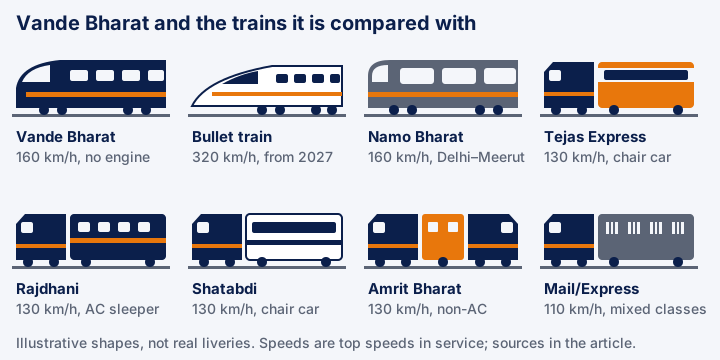
This guide puts the Vande Bharat train side by side with every train it is usually compared with: Rajdhani, Shatabdi, Tejas, Amrit Bharat, Namo Bharat, the bullet train and an ordinary Mail/Express. It gives one table with the key facts, a short section on each train with a link to the detailed comparison, and a “which should you book” guide by trip type. Vande Bharat fares come from IRCTC fare checks in November 2026. Facts about the other trains come from the Ministry of Railways, PIB, NCRTC, IRCTC and newspapers, each linked where it is used.
Vande Bharat train vs Vande Bharat Express: are they different?
No. “Vande Bharat train” and “Vande Bharat Express” are the same train. Vande Bharat Express is the official name, and people shorten it to Vande Bharat train. The first one started on 15 February 2019 between New Delhi and Varanasi Source: PIB, 23 July 2026.
What does differ is the version:
- Vande Bharat Express (Chair Car) is the daytime train most people mean. It has seats in AC Chair Car (CC) and Executive Chair Car (EC). Our checked timetables list 162 Chair Car services.
- Vande Bharat Sleeper is the overnight version, with berths in 3A, 2A and 1A. The first, Howrah–Kamakhya, began on 22 January 2026 Source: PIB. It has 16 coaches for about 823 passengers Source: PIB, 1 January 2026. Six Sleeper services now run on three routes.
- Namo Bharat Rapid Rail is a short-distance Indian Railways service that the Ministry says uses “the features of Vande Bharat Trains” for regional commuters Source: PIB, 23 July 2026. It is not the same as the Delhi–Meerut Namo Bharat, which is covered below.
For the basics of the train itself, see what is Vande Bharat Express. The full list of services is on the Vande Bharat trains page.
Vande Bharat vs other trains: the comparison table
| Top speed in service | Design speed | Classes | AC? | Seats or berths | Meals | Fare rule | Dynamic fare | Run by | Typical trip | |
|---|---|---|---|---|---|---|---|---|---|---|
| Vande Bharat Express | 160 km/h | 180 km/h | CC, EC | Fully AC | Seats | Optional, chosen at booking | Base fare 1.4 × Shatabdi in CC, 1.3 × in EC | No | Indian Railways | Day, 269–881 km |
| Vande Bharat Sleeper | Not published separately | 180 km/h | 3A, 2A, 1A | Fully AC | Berths | Included in fare | ₹2.40 per km in 3A, up to ₹3.80 in 1A | No | Indian Railways | Overnight, 758–1,114 km |
| Rajdhani | 130 km/h | Not published | 1A, 2A, 3A | Fully AC | Berths | Optional, chosen at booking | Flexi fare, up to 1.4 × base (not in 1A) | Yes | Indian Railways | Overnight, long distance |
| Shatabdi | 130 km/h | Not published | CC, EC | Fully AC | Seats | Optional, chosen at booking | Flexi fare, up to 1.4 × base (not in EC) | Yes, except EC | Indian Railways | Day, e.g. Howrah–Puri 502 km |
| Tejas Express | 130 km/h (at launch) | “Capable of” 200 km/h | CC, EC | Fully AC | Seats | In the fare at launch on IRCTC Tejas; now varies by train | IRCTC Tejas: rises in 10% steps, up to 30% | Yes, on IRCTC Tejas | IRCTC or Indian Railways | Day |
| Amrit Bharat | 130 km/h | Not published | Sleeper (SL), General | Non-AC | Berths and unreserved seats | Pantry car | About ₹500 per 1,000 km in Sleeper | No | Indian Railways | Long distance |
| Namo Bharat (Delhi–Meerut) | 160 km/h | 180 km/h | Standard, Premium | AC | Seats, 2+2 | — | Set by NCRTC | Not stated | NCRTC | Commuter, 82 km line |
| Bullet train (Mumbai–Ahmedabad) | 320 km/h (planned) | 350 km/h | Not announced | — | — | — | Not announced | — | NHSRCL | 508 km in about 1 h 58 min |
| Mail/Express | 110 km/h on many | Not published | Varies by train | AC and non-AC | Both | Varies | Standard fare | No flexi fare | Indian Railways | Any |
Sources for every row are linked in the sections below. The Vande Bharat trip lengths come from our checked timetables: the shortest Chair Car route is Jammu Tawi–Srinagar at 269 km, the longest Pune–Ajni at 881 km, and the longest Sleeper Mumbai CSMT–SMVT Bengaluru at 1,114 km.
Speed: how Vande Bharat compares with other trains
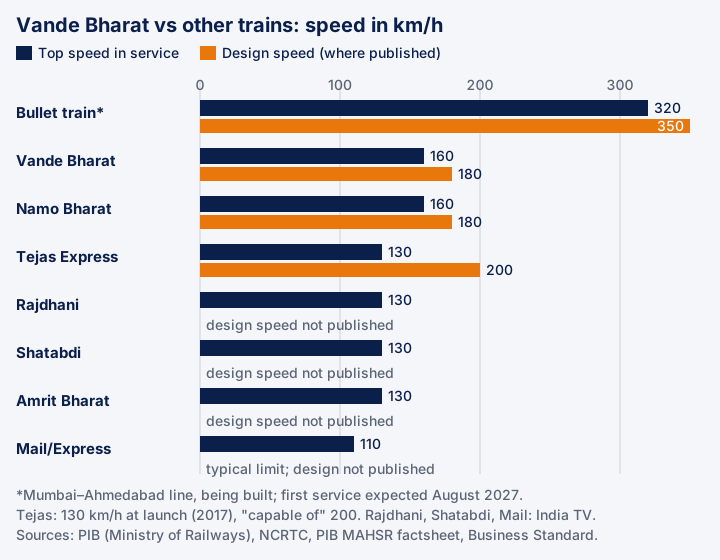
The numbers in the chart and their sources:
- Vande Bharat: 160 km/h in service, 180 km/h design. The Ministry of Railways gives a “design speed of 180 kmph and maximum operating speed of 160 kmph” Source: PIB, 25 July 2025. The Sleeper is also designed for 180 km/h Source: PIB, 1 January 2026.
- Namo Bharat: 160 km/h operating, 180 km/h design Source: NCRTC corporate folder, April 2025.
- Bullet train: 320 km/h operating, 350 km/h design for the Mumbai–Ahmedabad corridor Source: PIB factsheet, 3 July 2026.
- Tejas: 130 km/h at its 2017 launch. Reports said the train “will run at a speed of 130 kmph” and “is capable of running at 200 kmph” Source: Business Standard (IANS), 22 May 2017.
- Amrit Bharat: up to 130 km/h, with a locomotive at each end (push-pull) Source: PIB, 10 March 2026.
- Rajdhani and Shatabdi: 130 km/h. Many Mail/Express trains: 110 km/h. India TV reported in June 2026 that a maximum operational speed of 130 km/h “is largely restricted to premium services” such as Rajdhani, Shatabdi, Duronto and Vande Bharat. It also reported a Railway Board plan to raise about 400 Mail, Express and Superfast trains from 110 to 130 km/h Source: India TV, 5 June 2026.
Top speed is not journey speed. A Vande Bharat may run at 160 km/h only where the track is cleared for it. Across all 162 Chair Car services, the average speed over the whole journey, stops included, is 72.5 km/h. The fastest is 22229 Mumbai CSMT–Madgaon at 98.7 km/h. The full analysis is in Vande Bharat speed and fastest routes. Vande Bharat’s real advantage is how fast it picks up speed: the second-generation train goes from 0 to 100 km/h in about 52 seconds Source: PIB, 9 September 2022. It has motors along the train instead of one locomotive at the front, so it loses less time at each stop and each slow stretch.
Vande Bharat vs Shatabdi
This is the most direct comparison, because both are daytime, all-AC Chair Car trains with CC and EC. On the two routes where we could compare them between the same stations, Vande Bharat was faster: 6 h 50 min against 7 h 55 min from Howrah to Puri, and 6 h 30 min against 7 h from Chennai Central to Mysuru.
The fares work differently. The Vande Bharat base fare is set at 1.4 times the Shatabdi fare in CC and 1.3 times in EC Source: Ministry of Railways via PIB. Shatabdi, however, carries a flexi fare. On 11 November 2026, IRCTC priced the Howrah–Puri Vande Bharat 22895 at ₹1,485 in CC with the meal, and the Shatabdi 12277 at ₹1,410, of which ₹284 was dynamic fare. Without meals, the Vande Bharat was slightly cheaper that day.
Full details: Vande Bharat vs Shatabdi.
Vande Bharat vs Rajdhani
A Rajdhani is an overnight AC sleeper train with First, Second and Third AC Source: Seat61. A Vande Bharat Express is a day train with seats. They suit different trips, so the fair comparison is Vande Bharat Sleeper vs Rajdhani.
Two rules separate them. Rajdhani uses the flexi fare scheme. Since 9 September 2016, its fares rise as berths sell in every reserved class except First AC Source: PIB via Business Standard, 27 July 2017. Since 2019, the rise is capped at 1.4 times the base fare Source: DT Next (PTI), 24 July 2019. The Vande Bharat Sleeper has no dynamic fare. The Ministry prices it at ₹2.40 per km in 3A, with food included and no RAC tickets Source: PIB, March 2026. The rates reported for the other classes are ₹3.10 per km in 2A and ₹3.80 in 1A Source: The Quint, 12 January 2026. Rajdhani meals are optional and chosen when you book online Source: NewsX, 9 December 2025. On New Delhi–Varanasi, IRCTC priced the Sleeper 27422 at ₹1,915 in 3A, ₹2,470 in 2A and ₹3,030 in 1A on 11 November 2026.
Full details: Vande Bharat vs Rajdhani. Sleeper routes: Vande Bharat Sleeper.
Vande Bharat vs Tejas
“Tejas” covers three services: two IRCTC-run trains (Lucknow–New Delhi and Mumbai–Ahmedabad), two Indian Railways Tejas trains, and Tejas Rajdhani sleepers. The IRCTC Tejas was launched in October 2019 as the first train run by IRCTC instead of a zonal railway Source: Business Standard (PTI), 4 October 2019. IRCTC prices it dynamically: when the trains restarted in 2021, a block of seats was sold at a reduced fare, after which the fare rose in 10% steps, to at most 30% more Source: IRCTC press release, 29 January 2021.
On every route we checked where both trains run between the same stations, Vande Bharat was faster. For example, it is 1 hour 5 minutes quicker from Mumbai Central to Ahmedabad, where IRCTC priced the Vande Bharat 22961 at ₹1,385 in CC on 11 November 2026. Tejas has extras that Vande Bharat lacks: at launch, IRCTC promised to pay passengers for delays and gave free travel insurance Source: Business Standard (PTI), 4 October 2019. Meals were part of the IRCTC Tejas fare at launch Source: PIB, 30 December 2019, but on 12 November 2026 erail showed food included for 82901 and not for 82501.
Full details: Vande Bharat vs Tejas.
Vande Bharat vs Amrit Bharat
These two are built for different passengers. Amrit Bharat is “fully non-AC”, with 11 General Class coaches, 8 Sleeper Class coaches, a pantry car and two guard-cum-luggage vans with compartments for disabled passengers. It has run since December 2023 and costs about ₹500 per 1,000 km in Sleeper, with no dynamic pricing Source: PIB backgrounder, 17 January 2026. The Ministry counted 72 Amrit Bharat services in July 2026 Source: PIB, 23 July 2026.
The price gap is large. The Vande Bharat 22436 cost ₹1,835 in CC for the 771 km from New Delhi to Varanasi on 11 November 2026. At the Ministry’s rate of about ₹500 per 1,000 km, an Amrit Bharat sleeper berth for a similar distance works out to roughly ₹400. That is a rough figure, because PIB gives only the approximate rate. What you get for the extra money is air-conditioning, a reserved seat in every coach and a much faster journey. Amrit Bharat is limited to 130 km/h and pulled by locomotives.
Full details: Vande Bharat vs Namo Bharat vs Amrit Bharat.
Vande Bharat vs Namo Bharat
Namo Bharat on the Delhi–Ghaziabad–Meerut line is a regional rapid transit train, not an Indian Railways long-distance train. It is run by the National Capital Region Transport Corporation (NCRTC) on its own standard-gauge track. It has air-conditioned Standard and Premium coaches with 2+2 seating, and trains every 10 to 15 minutes Source: NCRTC corporate folder, April 2025. The full 82 km corridor opened on 22 February 2026 Source: PIB, 22 February 2026.
Which is better, Namo Bharat or Vande Bharat? Neither, because they do different jobs. Both have a top speed of 160 km/h and a design speed of 180 km/h. Namo Bharat is a commuter service for trips of under 82 km with frequent trains. Vande Bharat connects cities hundreds of kilometres apart with a few reserved trains a day. You cannot travel between Delhi and Meerut on a Vande Bharat Chair Car, and you cannot reach anywhere beyond Meerut on Namo Bharat.
Full details: Vande Bharat vs Namo Bharat vs Amrit Bharat.
Vande Bharat vs bullet train
The bullet train will be twice as fast, but it is not running yet. The Mumbai–Ahmedabad High Speed Rail corridor has a design speed of 350 km/h and an operational speed of 320 km/h. It is about 508 km long, with 12 stations, and should cover the route in about 1 hour 58 minutes. The first service, from Surat to Vapi, is expected in August 2027 Source: PIB factsheet, 3 July 2026. It is built by the National High-Speed Rail Corporation Limited (NHSRCL) using Japanese Shinkansen technology, on a separate line of its own.
Vande Bharat is a semi-high-speed train on India’s existing broad-gauge tracks, shared with other trains. Today, the Mumbai Central–Ahmedabad Vande Bharat 22961 covers 491 km in 5 hours 30 minutes, at ₹1,385 in CC. The bullet train’s fares have not been announced, so a price comparison is not possible yet. The same factsheet says ICF and BEML are building Indian high-speed trainsets for 280 km/h Source: PIB factsheet, 3 July 2026.
Vande Bharat train vs normal train
Compared with an ordinary Mail or Express train, a Vande Bharat train differs in five ways:
- Speed. 160 km/h against 110 km/h for many Mail/Express trains Source: India TV, 5 June 2026, and much quicker acceleration.
- No engine. Vande Bharat is a self-propelled trainset with motors along its length. A normal train is pulled by a locomotive.
- All AC, all reserved. Every Vande Bharat coach is air-conditioned, and there are no General or Sleeper class (SL) coaches Source: PIB backgrounder. A normal express usually carries unreserved and non-AC coaches as well.
- Price. Vande Bharat costs more. Its base fare is set above Shatabdi, which is already a premium fare.
- No dynamic fare. The Ministry says there is no plan to bring dynamic fares to Vande Bharat Source: PIB, February 2026. Normal Mail/Express trains have no flexi fare either; it applies only to premium trains Source: PIB via Business Standard, 27 July 2017.
Which should you book? By trip type
A daytime trip between two cities, up to about 800 km: check the Vande Bharat first. It is usually the fastest train on the route, and its price does not rise as seats sell. If it is waitlisted, or the Shatabdi or Tejas timing suits you better, compare their totals on IRCTC for your date.
An overnight trip: if your route has a Vande Bharat Sleeper, compare it with the Rajdhani on the same date. The Sleeper has a fixed price with food included. The Rajdhani’s flexi fare can push the price up on busy days. Otherwise, the Rajdhani or another overnight express is your choice. A Vande Bharat Chair Car is not built for sleeping.
The lowest fare over a long distance: Amrit Bharat or an ordinary express in Sleeper class. You give up air-conditioning and some speed for a much lower fare.
Delhi to Ghaziabad or Meerut: Namo Bharat. It runs every 10 to 15 minutes, and no Vande Bharat serves that short trip.
Mumbai to Ahmedabad: until the bullet train opens, the Vande Bharat 22961/22962 is the fastest scheduled train we have checked on the route, ahead of the IRCTC Tejas.
Comfort and space in a day train: book EC instead of CC. EC has 2+2 seats that rotate, against 3+2 in CC, at about 1.8 times the fare: ₹2,665 against ₹1,485 from Howrah to Puri. See CC vs EC.
Before booking, check the Vande Bharat ticket price for your route and look up the train on the route list.
Vande Bharat vs other trains FAQs
Which train is better than Vande Bharat? For speed, we have found no train running in India today with a higher top speed than Vande Bharat’s 160 km/h. The Namo Bharat matches it on the 82 km Delhi–Meerut line. The Mumbai–Ahmedabad bullet train, planned for 320 km/h, will be faster once it opens. Its first section is expected in August 2027. For a night journey, a sleeper train such as the Rajdhani or Vande Bharat Sleeper is better. For a low fare, Amrit Bharat is far cheaper.
Is Vande Bharat better than other trains? For daytime trips between cities, usually yes. It was faster than Shatabdi and Tejas on every route we compared, and it has no dynamic fare. It costs more than an ordinary express, and it has no non-AC or unreserved coaches.
Which one is better, Shatabdi or Vande Bharat? Vande Bharat is faster: 1 hour 5 minutes quicker from Howrah to Puri. Its base fare is 1.4 times Shatabdi’s in CC, but Shatabdi can add a flexi fare, so the totals can be close. On 11 November 2026, they were ₹1,485 and ₹1,410 in CC with meals.
Which is better, Namo Bharat or Vande Bharat? They do different jobs. Namo Bharat is a frequent commuter train on one 82 km line around Delhi. Vande Bharat connects cities hundreds of kilometres apart. Both have a top speed of 160 km/h.
Is Vande Bharat train different from Vande Bharat Express? No, they are the same train. Vande Bharat Express is the official name. The Chair Car version runs by day; the Vande Bharat Sleeper is the overnight version with berths.
Is Vande Bharat faster than Rajdhani? By top speed, yes: 160 km/h against 130 km/h. A Rajdhani is an overnight sleeper, so compare it with the Vande Bharat Sleeper on the same route and date.
Is Vande Bharat a bullet train? No. It is a semi-high-speed train on existing tracks, with a top speed of 160 km/h. India’s bullet train runs on its own line at 320 km/h, and it is not open yet.
What is the difference between Vande Bharat and a normal train? Vande Bharat has no locomotive, is fully air-conditioned and reserved, runs at up to 160 km/h against 110 km/h for many Mail/Express trains, and costs more. It has no dynamic fare.
Is Amrit Bharat the same as Vande Bharat? No. Amrit Bharat is a non-AC train with Sleeper and General coaches, pulled by locomotives at both ends, with a top speed of 130 km/h and a much lower fare.
Related
- Vande Bharat vs Shatabdi
- Vande Bharat vs Rajdhani
- Vande Bharat vs Tejas
- Vande Bharat vs Namo Bharat vs Amrit Bharat
- CC vs EC
- Vande Bharat speed and fastest routes
- What is Vande Bharat Express?
- All Vande Bharat trains · Route list · Ticket price
Sources
- Vande Bharat fares: IRCTC fare enquiry (1 adult, general quota), checked 11 November 2026, for 22895, 22961, 22436 and Sleeper 27422, and Shatabdi 12277. Vande Bharat timetables, trip lengths and average speeds: our checked timetables, 11 November 2026.
- Ministry of Railways via PIB: Vande Bharat speeds, 25 July 2025 · 0–100 km/h in 52 seconds, 9 September 2022 · Sleeper coaches and design speed, 1 January 2026 · first Sleeper, Howrah–Kamakhya · Sleeper fares, March 2026 · no dynamic fare, February 2026 · Vande Bharat fare rule · Vande Bharat backgrounder · Vande Bharat, Amrit Bharat and Namo Bharat Rapid Rail services, 23 July 2026 · Amrit Bharat backgrounder, 17 January 2026 · Amrit Bharat 130 km/h, 10 March 2026 · Delhi–Meerut Namo Bharat corridor, 22 February 2026 · Mumbai–Ahmedabad High Speed Rail factsheet, 3 July 2026 · flexi fare in premium trains, July 2017 (via Business Standard).
- NCRTC: corporate folder, April 2025. IRCTC: Tejas press release, 29 January 2021.
- News reports: India TV, 5 June 2026 · Business Standard (IANS), 22 May 2017 · Business Standard (PTI), 4 October 2019 · DT Next (PTI), 24 July 2019 · Seat61, Rajdhani classes · The Quint, 12 January 2026 · NewsX, 9 December 2025.
- All checked 12 November 2026. Found a mistake? Report a correction.
Keep reading about Vande Bharat
Vande Bharat Train Review: Is It Worth It?
An evidence-based Vande Bharat train review: speed, seats, food, toilets, punctuality, price, booking and the Vande Bharat Sleeper, each judged on official data, IRCTC fares and what passengers report. Is Vande Bharat worth it?
Vande Bharat vs Shatabdi: Which Is Faster and Cheaper?
Vande Bharat vs Shatabdi compared on the same routes: journey time, real IRCTC fares, base fare rule, dynamic fare and meals. Which is faster, which is cheaper, and which to book.
Vande Bharat vs Rajdhani: Which Train Should You Book?
Vande Bharat vs Rajdhani Express on the same tracks: real timetable times, top speed, CC, EC and sleeper classes, flexi fare against fixed fare, meals, and which train to book.
Vande Bharat vs Tejas Express: Which Is Faster and Better?
Vande Bharat vs Tejas Express on the same routes: journey times, top speed, seating, meals, dynamic fares and IRCTC Tejas delay compensation. Includes the difference between IRCTC Tejas, Indian Railways Tejas and Tejas Rajdhani.