
Vande Bharat vs Tejas Express: Which Is Faster and Better?
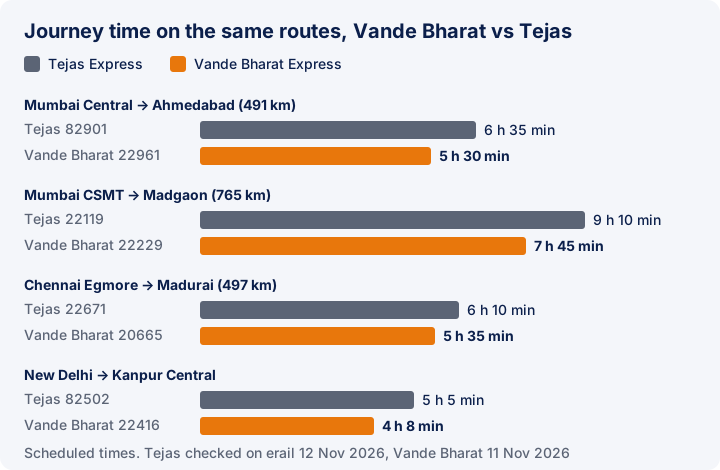
Vande Bharat Express is faster than Tejas Express on every route where both trains run between the same stations. On Mumbai Central–Ahmedabad it is 1 hour 5 minutes quicker, and on Mumbai CSMT–Madgaon 1 hour 25 minutes quicker. Tejas has its own strengths: the two IRCTC-run Tejas trains were launched with meals in the fare, free travel insurance and cash compensation when the train runs more than an hour late. Vande Bharat has a fixed fare with no dynamic pricing, while IRCTC’s Tejas tickets are priced dynamically. For most daytime trips the Vande Bharat train is the better pick on time; the Tejas is worth checking when its departure suits you or the Vande Bharat is waitlisted.
On this page
- Three kinds of Tejas train
- Vande Bharat vs Tejas Express at a glance
- Which is faster, Tejas or Vande Bharat?
- Seating: CC and EC on both trains
- Food: is the meal included?
- Fares and dynamic pricing
- Refunds, compensation and quotas on the IRCTC Tejas
- Which routes does each train run?
- Which should you book?
- Vande Bharat vs Tejas FAQs
- Related
- Sources
“Tejas” is not one kind of train. The name covers three different services, and most confusion in Vande Bharat vs Tejas comparisons comes from mixing them up. This guide separates them first, then compares speed, seats, food, fares and refund rules using official releases and timetables we checked on 12 November 2026.
Three kinds of Tejas train
In a December 2022 reply to Parliament, the Ministry of Railways listed four Tejas Express pairs and, separately, four Rajdhani pairs running with Tejas coaches Source: PIB, 7 December 2022. Who runs each Tejas Express splits that first group in two:
- IRCTC Tejas Express (train numbers starting with 8). 82501/82502 Lucknow–New Delhi and 82901/82902 Mumbai Central–Ahmedabad. These are run by IRCTC, the railway’s catering and tourism company, not by a zonal railway. The Ministry called the Ahmedabad–Mumbai train the “second premium Train to be run by IRCTC”, after Lucknow–Delhi Source: PIB, 30 December 2019. Newspapers called them India’s first “private” trains, but the Tribune’s report from on board points out they are corporate-run, not privately owned Source: The Tribune, 20 October 2019.
- Indian Railways Tejas Express. 22119/22120 Mumbai CSMT–Karmali/Madgaon and 22671/22672 Chennai Egmore–Madurai. These are normal Indian Railways trains that use Tejas-type coaches. The Mumbai–Goa train was the first Tejas of all, introduced in May 2017 Source: PIB, 21 May 2017.
- Tejas Rajdhani Express. Four Rajdhani trains that run with Tejas-type sleeper coaches: 20501/20502 Agartala–Anand Vihar, 12309/12310 Rajendra Nagar (Patna)–New Delhi, 12951/12952 Mumbai Central–New Delhi and 12953/12954 August Kranti Source: PIB, 7 December 2022. These are overnight sleeper trains, so the fair comparison for them is the Vande Bharat Sleeper, not the Vande Bharat Chair Car.
The first two kinds are daytime Chair Car trains with CC and EC, like the Vande Bharat Express, so they are what this guide compares. All of them still ran on 12 November 2026, when we checked their timetables on erail (82901, 82501, 22119, 22671).
Vande Bharat vs Tejas Express at a glance
| Vande Bharat Express | IRCTC Tejas (82501, 82901) | Indian Railways Tejas (22119, 22671) | |
|---|---|---|---|
| Run by | Indian Railways | IRCTC | Indian Railways |
| Train type | Self-propelled trainset, no locomotive | Locomotive-hauled Tejas coaches | Locomotive-hauled Tejas coaches |
| Classes | CC and EC | CC and EC | CC and EC (22119 also has a Vistadome coach) |
| Speed figure | 160 km/h in service, 180 km/h design | Tejas Express “capable of running at the speed of 200 kmph” (PIB, 2017) | Same |
| Dynamic fare | No | Yes | Not stated on official pages we found |
| Meal | Optional, chosen at booking | In the fare (82901, per erail) | Optional at launch (2017) |
| Tatkal | Yes | No, at launch | Not stated on official pages we found |
| Delay compensation | No, only the normal 3-hour refund rule | ₹100 after 1 hour, ₹250 after 2 hours (launch terms) | No |
| Routes | 84 routes across India | 2 | 2 |
Sources for each row are in the sections below.
Which is faster, Tejas or Vande Bharat?
Vande Bharat, on all four routes where both run between the same stations. We compared the scheduled timetables:
| Route | Tejas | Vande Bharat | Vande Bharat saves |
|---|---|---|---|
| Mumbai Central → Ahmedabad (491 km) | 82901: 15:55 → 22:30, 6 h 35 min | 22961: 15:45 → 21:15, 5 h 30 min | 1 h 5 min |
| Ahmedabad → Mumbai Central | 82902: 06:35 → 13:20, 6 h 45 min | 22962: 06:05 → 11:45, 5 h 40 min | 1 h 5 min |
| Mumbai CSMT → Madgaon (765 km) | 22119: 05:50 → 15:00, 9 h 10 min | 22229: 05:25 → 13:10, 7 h 45 min | 1 h 25 min |
| Chennai Egmore → Madurai (497 km) | 22671: 06:00 → 12:10, 6 h 10 min | 20665: 15:10 → 20:45, 5 h 35 min | 35 min |
| Madurai → Chennai Egmore | 22672: 15:30 → 21:45, 6 h 15 min | 20666: 08:00 → 14:00, 6 h | 15 min |
| New Delhi → Kanpur Central | 82502: 15:30 → 20:35, 5 h 5 min | 22416: 15:00 → 19:08, 4 h 8 min | 57 min |
Tejas times are from erail (82901, 82902, 22119, 22671, 22672, 82502), checked 12 November 2026. Vande Bharat times are from our checked timetables on the Mumbai–Ahmedabad, Mumbai–Goa, Chennai–Tirunelveli and Delhi–Varanasi pages.
The gap is not new. In 2019 the Tribune noted that the New Delhi–Varanasi Vande Bharat covered the 439 km New Delhi–Kanpur section in 4.05 hours, against five hours on the new Lucknow Tejas Source: The Tribune, 20 October 2019. Seven years later the difference on that stretch is still close to an hour.
Why is Vande Bharat faster if Tejas is rated at 200 km/h?
The 200 km/h figure is the Ministry’s description of what the Tejas Express can do, from the 2017 launch release Source: PIB, 21 May 2017. It is not the speed the trains run at. The Vande Bharat figures are a design speed of 180 km/h and a maximum operating speed of 160 km/h where the route allows Source: PIB, 25 July 2025. On the same track, both trains are held to the same section limits, so the top-speed number on paper decides very little.
What decides it is how the train picks up speed. A Tejas is a set of coaches pulled by a locomotive. A Vande Bharat is a self-propelled trainset with no separate engine Source: PIB backgrounder, and the second version goes from 0 to 100 km/h in about 52 seconds Source: PIB, 9 September 2022. After every stop, speed restriction and curve, the Vande Bharat train gets back to line speed sooner, and those seconds add up over 500 or 700 km. The timetables show the result: 22961 averages about 89 km/h from Mumbai Central to Ahmedabad, while 82901 averages about 75 km/h on the same 491 km. The full breakdown of Vande Bharat speeds is in our Vande Bharat speed guide: across all Chair Car services the average is 72.5 km/h, and 22229 to Goa is the fastest at 98.7 km/h.
Seating: CC and EC on both trains
Both are all-reserved, air-conditioned seated trains with two classes:
- AC Chair Car (CC): rows of five seats (3+2) on both. On the IRCTC Tejas, the Ministry listed eight Chair Cars of 78 seats each at launch Source: PIB, 30 December 2019. A Vande Bharat CC coach also has 78 seats, with 44 in each driving coach (CC vs EC).
- Executive Chair Car (EC): rows of four (2+2). The IRCTC Tejas launched with two EC coaches of 56 seats each, a total train capacity of 736 Source: PIB, 30 December 2019. A Vande Bharat EC coach has 52 seats, and its EC seats rotate to face the direction of travel.
The Tribune’s 2019 report confirms the 2+2 Executive and 3+2 Chair Car layout on the Lucknow Tejas Source: The Tribune. See our Vande Bharat seat maps for the layout and window seat numbers.
The Mumbai–Goa Tejas 22119 has one class the Vande Bharat does not: a Vistadome (EV) coach with large windows, listed in its class line on erail. On the Konkan coast that view can be a reason to pick the slower train.
Coach features
The Ministry describes Tejas coaches as having “automatic entrance doors, Passenger Announcement/Passenger Information system, Fire and Smoke detection system, CCTV cameras”, and Vande Bharat trains as having quick acceleration, onboard infotainment, GPS-based passenger information, automatic sliding doors, retractable footsteps and zero-discharge vacuum bio toilets Source: PIB, 7 December 2022. In practice the features overlap a lot. The real differences are the trainset design, which gives Vande Bharat its speed, and the service model, which on the IRCTC Tejas is run by IRCTC with airline-style trolley service. More on the Vande Bharat side is in our facilities guide.
Food: is the meal included?
- IRCTC Tejas: at launch the Ministry said food and beverages “will be provided to the passengers on board in the train and included in the ticket fare”, served from trolleys “similar to airlines”, with an RO water filter in each coach and a water bottle for each passenger Source: PIB, 30 December 2019. On 12 November 2026, erail still showed “Fare includes food cost” for 82901, but “Fare does not include food cost” for 82501, so check the IRCTC booking screen for your train.
- Indian Railways Tejas: when 22119 started in 2017, the meal was an option at booking. If you skipped it and bought on board, there was an extra ₹50 per service, and ₹20 was added to every fare for water and a newspaper Source: PIB, 21 May 2017.
- Vande Bharat Express: the meal is optional and you choose it when booking. On 22961 Mumbai Central–Ahmedabad, the meal charge was ₹307 in CC and ₹368 in EC on IRCTC’s fare breakdown of 11 November 2026. See Vande Bharat food.
Fares and dynamic pricing
This is the biggest structural difference between the two trains.
Vande Bharat Express has no dynamic fare. The Ministry of Railways said in February 2026 that there is no plan to bring dynamic fares to Vande Bharat Source: PIB, February 2026, and every Vande Bharat fare we have checked on IRCTC showed a dynamic fare of ₹0. The base fare is set at 1.4 times the Shatabdi fare in CC and 1.3 times in EC Source: Ministry of Railways via PIB.
IRCTC Tejas tickets are priced dynamically. The Tribune reported in 2019 that “a ticket on the Tejas is based on dynamic pricing”, and found the Delhi–Lucknow fare at ₹1,755 in CC and ₹2,450 in EC for one date Source: The Tribune, 20 October 2019. Those are 2019 prices for one day, not a current fare. With dynamic pricing, the price climbs as seats sell, so the same IRCTC Tejas seat can cost noticeably more close to the date than when booking opens.
Here are Vande Bharat fares on the two shared routes from IRCTC’s fare enquiry, one adult, journey date 11 November 2026:
| Vande Bharat train | Class | Base fare | Meal | Dynamic fare | Total |
|---|---|---|---|---|---|
| 22961 Mumbai Central → Ahmedabad | CC | ₹941 | ₹307 | ₹0 | ₹1,385 |
| 22961 Mumbai Central → Ahmedabad | EC | ₹1,900 | ₹368 | ₹0 | ₹2,505 |
| 22229 Mumbai CSMT → Madgaon | CC | ₹1,314 | ₹156 | ₹0 | ₹1,625 |
| 22229 Mumbai CSMT → Madgaon | EC | ₹2,680 | ₹189 | ₹0 | ₹3,145 |
We have not checked a current IRCTC fare for the Tejas trains, so we do not print one. For a fair comparison, search your date on IRCTC, open both trains, and compare the totals with and without the meal. For history only: when the Mumbai–Goa Tejas launched in May 2017, CSMT to Karmali cost ₹1,310 in CC with catering and ₹1,185 without, outside the monsoon Source: PIB, 21 May 2017. How every part of a Vande Bharat fare is built is explained on our Vande Bharat ticket price page.
Refunds, compensation and quotas on the IRCTC Tejas
When IRCTC launched the Ahmedabad–Mumbai Tejas, the Ministry announced a set of rules that no Vande Bharat train has Source: PIB, 30 December 2019:
- Delay compensation: ₹100 to every passenger if the train is more than one hour late, and ₹250 if it is more than two hours late.
- Free travel insurance of up to ₹25 lakh per passenger, including ₹1 lakh cover against household theft or robbery during the trip.
- Automatic full refund if the train is cancelled, on confirmed and waitlisted e-tickets, with no need to cancel or file a TDR.
- No Tatkal or Premium Tatkal. Only General Quota and a Foreign Tourist Quota (6 seats in EC, 12 in CC).
- Online booking only, on the IRCTC website, the IRCTC Rail Connect app and IRCTC’s travel portal partners, not at railway counters.
These are launch terms from 2019. We could not find a current official IRCTC page confirming each one in November 2026, so check the terms shown on IRCTC when you book.
Vande Bharat Express follows the normal Indian Railways rules. There is no cash compensation for a delay. If the train runs more than 3 hours late and you choose not to travel, you get the full fare back; a cancelled train is refunded automatically. Details are in our late train refund guide and cancellation charges guide. Vande Bharat does have Tatkal, which the IRCTC Tejas did not at launch: see Vande Bharat Tatkal.
Which routes does each train run?
Tejas Express runs on four daytime routes (plus the four Tejas Rajdhani sleeper routes listed above):
| Train | Route | Days (erail, 12 Nov 2026) | Vande Bharat on the same route? |
|---|---|---|---|
| 82901/82902 (IRCTC) | Mumbai Central – Ahmedabad | Except Thursday | Yes: 22961/22962 and 20901/20902 |
| 82501/82502 (IRCTC) | Lucknow – New Delhi | Except Tuesday | No direct Vande Bharat; 22416/22415 share New Delhi–Kanpur |
| 22119/22120 | Mumbai CSMT – Madgaon | 22119: Tue, Wed, Fri, Sat, Sun | Yes: 22229/22230 |
| 22671/22672 | Chennai Egmore – Madurai | Except Thursday | Yes: 20665/20666 (to Tirunelveli) and 20627/20628 (to Nagercoil) |
Vande Bharat Express runs 168 services on 84 routes, from Kashmir to Kerala, in our checked timetables. See the full Vande Bharat trains list and routes by state. Outside these four corridors, there is no daytime Tejas to compare with.
One route matters for Lucknow travellers. There is no direct Vande Bharat between Lucknow and New Delhi in our timetables, so for Lucknow the 82501/82502 IRCTC Tejas remains one of the fastest daytime options at 6 hours 25 minutes for 512 km (erail 82501).
Which should you book?
Book the Vande Bharat Express if:
- you want the shortest journey: it saves 15 minutes to 1 hour 25 minutes on the routes above;
- you want a price that does not rise as seats sell;
- you are booking late and need Tatkal;
- the Vande Bharat departure suits you. On Mumbai–Goa, 22229 reaches Madgaon at 13:10, almost two hours before the Tejas.
Book the Tejas Express if:
- its timing fits your day better. From Madurai the Tejas 22672 leaves at 15:30, while the Vande Bharat 20666 leaves at 08:00;
- the Vande Bharat is waitlisted on your date;
- you are on the Konkan line and want the Vistadome coach on 22119;
- you travel Lucknow–Delhi, where there is no direct Vande Bharat;
- you value the IRCTC Tejas delay compensation and insurance, after checking they still apply to your booking.
On Mumbai Central–Ahmedabad the two trains leave ten minutes apart in the afternoon (15:45 and 15:55), so it is a straight choice: the Vande Bharat reaches Ahmedabad 1 hour 15 minutes earlier. Compare both fares on IRCTC for your date before you pay.
Vande Bharat vs Tejas FAQs
Which is faster, Tejas or Vande Bharat? Vande Bharat. Between the same stations it is 1 hour 5 minutes faster from Mumbai Central to Ahmedabad, 1 hour 25 minutes faster from Mumbai CSMT to Madgaon, 35 minutes faster from Chennai Egmore to Madurai and 57 minutes faster from New Delhi to Kanpur.
Is Tejas Express a private train? No. The IRCTC Tejas trains 82501/82502 and 82901/82902 are run by IRCTC, a company of the Ministry of Railways, which is why they were called corporate-run trains. 22119/22120 and 22671/22672 are normal Indian Railways trains.
What is the top speed of Tejas and Vande Bharat? The Ministry described Tejas as capable of 200 km/h in 2017. Vande Bharat has a design speed of 180 km/h and a maximum operating speed of 160 km/h. Both run within the limits of each section of track, and Vande Bharat’s faster acceleration is what makes it quicker.
Is Tejas costlier than Vande Bharat? It depends on the date. The IRCTC Tejas uses dynamic pricing, so its fare rises as seats sell; Vande Bharat has no dynamic fare. On Mumbai Central–Ahmedabad, the Vande Bharat 22961 cost ₹1,385 in CC and ₹2,505 in EC with meals on 11 November 2026. Compare the Tejas price on IRCTC for your date.
Is food free in Tejas Express? On the IRCTC Tejas, food was included in the ticket fare at launch, so it is not free but already paid for. On Vande Bharat the meal is optional and added to the fare if you choose it at booking.
Does Tejas Express pay compensation for delays? The IRCTC Tejas was launched with ₹100 per passenger for a delay of more than one hour and ₹250 for more than two hours. Vande Bharat has no delay compensation, but gives a full refund if the train is more than 3 hours late and you do not travel.
Can I book Tatkal on Tejas Express? Not on the IRCTC Tejas, according to its launch terms: only General and Foreign Tourist quotas. Vande Bharat trains do have Tatkal.
What is Tejas Rajdhani, and is it the same as Vande Bharat? Tejas Rajdhani is a Rajdhani Express running with Tejas-type sleeper coaches, such as the Mumbai Central–New Delhi Rajdhani. It is an overnight sleeper train, not a Chair Car train, so it compares with the Vande Bharat Sleeper rather than the Vande Bharat Express.
Related
- What is Vande Bharat Express?
- Vande Bharat vs Shatabdi
- Vande Bharat vs Rajdhani
- Vande Bharat vs other trains
- Vande Bharat vs Namo Bharat vs Amrit Bharat
- Vande Bharat speed and fastest routes
- Vande Bharat ticket price
- CC vs EC
- Mumbai Ahmedabad Vande Bharat and Mumbai Goa Vande Bharat
Sources
Tejas types and routes, coach features: PIB, 7 December 2022. First Tejas, 200 km/h, 2017 catering and fares: PIB, 21 May 2017. IRCTC Tejas seating, food, insurance, compensation, refund and quota rules: PIB, 30 December 2019. Dynamic pricing, 2019 fares, corporate-run status: The Tribune, 20 October 2019. Tejas timetables: erail 82901, 82902, 82501, 82502, 22119, 22671, 22672, 12 November 2026. Vande Bharat speed: PIB, 25 July 2025; acceleration: PIB, 9 September 2022. No dynamic fare: PIB, February 2026. Fare rule: Ministry of Railways via PIB. Vande Bharat fares: IRCTC fare enquiry, 11 November 2026. Report a correction.
Keep reading about Vande Bharat
Vande Bharat vs Other Trains: Which Is Better?
Is Vande Bharat better than other trains? Vande Bharat Express compared with Rajdhani, Shatabdi, Tejas, Amrit Bharat, Namo Bharat, the bullet train and a normal express: speed, classes, meals, fares and which to book.
Vande Bharat vs Shatabdi: Which Is Faster and Cheaper?
Vande Bharat vs Shatabdi compared on the same routes: journey time, real IRCTC fares, base fare rule, dynamic fare and meals. Which is faster, which is cheaper, and which to book.
Vande Bharat vs Rajdhani: Which Train Should You Book?
Vande Bharat vs Rajdhani Express on the same tracks: real timetable times, top speed, CC, EC and sleeper classes, flexi fare against fixed fare, meals, and which train to book.
Vande Bharat Ticket Price: Fares by Route
Vande Bharat Express ticket prices from IRCTC for popular routes in CC and EC, with and without meals. Full fare breakdown, Sleeper fares, and why Vande Bharat costs more than Shatabdi.