
Vande Bharat vs Namo Bharat vs Amrit Bharat: Which Train Is Better?
None of the three is better at everything, because they do different jobs. The Vande Bharat Express is a fully air-conditioned day train between cities, booked on IRCTC. Namo Bharat is a fully air-conditioned regional rapid train on the 82 km Delhi–Meerut corridor, run by NCRTC and not by Indian Railways, with tickets on its own app or an NCMC card. The Amrit Bharat Express is a non-AC long-distance train with sleeper berths and general seats, at about ₹500 per 1,000 km. Vande Bharat and Namo Bharat both run at up to 160 km/h. Amrit Bharat runs at up to 130 km/h.
On this page
- Vande Bharat vs Namo Bharat vs Amrit Bharat at a glance
- What each train is for
- Which is faster: Vande Bharat, Namo Bharat or Amrit Bharat?
- AC or non-AC, and what the seats are like
- How ticket booking works on each train
- Fares: how much does each one cost?
- Vande Bharat vs Amrit Bharat: the short answer
- Namo Bharat vs Vande Bharat: the short answer
- Which one should you book?
- Vande Bharat vs Namo Bharat vs Amrit Bharat FAQs
- Related
- Sources
So the right question is not “which train is best” but “which train fits this trip”. For Delhi to Meerut, Namo Bharat is the only one of the three that runs there. For a comfortable AC day trip of five to nine hours between two big cities, take the Vande Bharat train. For a long overnight journey on the lowest fare, take Amrit Bharat.
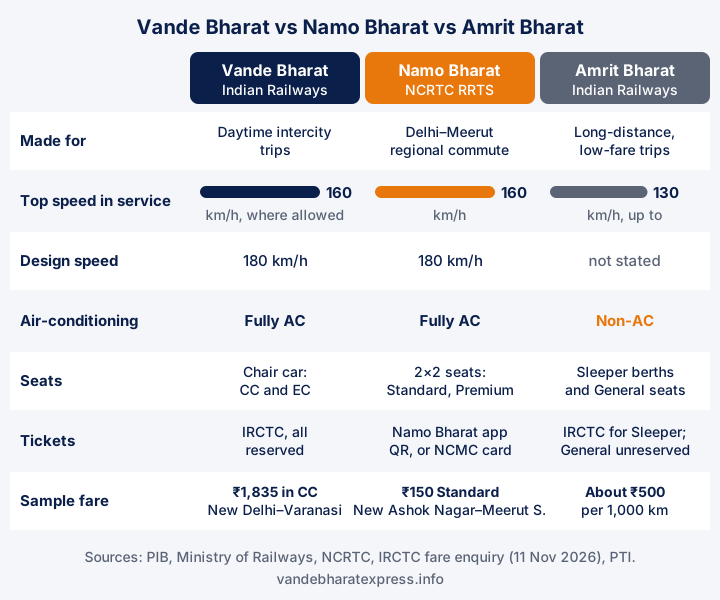
Vande Bharat vs Namo Bharat vs Amrit Bharat at a glance
| Vande Bharat Express | Namo Bharat (RRTS) | Amrit Bharat Express | |
|---|---|---|---|
| Run by | Indian Railways | NCRTC | Indian Railways |
| Made for | Daytime trips between cities | Delhi–Meerut regional commute | Long-distance budget travel |
| Top speed in service | 160 km/h, where the route allows | 160 km/h | Up to 130 km/h |
| Design speed | 180 km/h | 180 km/h | Not stated by the Ministry |
| AC | Fully AC | Fully AC | Fully non-AC |
| Seats | CC (3+2) and EC (2+2) chair cars | 2×2 seats, Standard and Premium, one coach for women | 8 Sleeper and 11 General coaches |
| Tickets | IRCTC, all reserved | Namo Bharat app (QR), ticket machines, NCMC card | IRCTC for Sleeper; General is unreserved |
| Sample fare | ₹1,835 in CC, New Delhi–Varanasi | ₹150 Standard, New Ashok Nagar–Meerut South | About ₹500 per 1,000 km |
| Dynamic fare | None | — | None |
Sources for every row are given in the sections below.
What each train is for
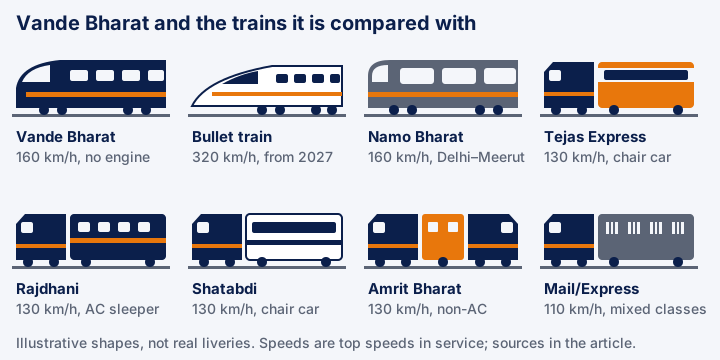
Vande Bharat Express: the AC day train between cities
The Vande Bharat Express is Indian Railways’ semi-high-speed train, built at the Integral Coach Factory in Chennai and running since 15 February 2019. It is a self-propelled trainset, so there is no separate engine. Most services link two large cities in a single day and offer two classes: AC Chair Car (CC) and Executive Chair Car (EC). In November 2026 we counted 168 Vande Bharat services on 84 routes, including the newer Vande Bharat Sleeper, which has berths instead of seats. The full story is in our guide What is Vande Bharat Express?, and every service is in the Vande Bharat trains list and routes list.
Namo Bharat: the regional rapid train around Delhi
Namo Bharat is the name of the trains on India’s first Regional Rapid Transit System (RRTS), the Delhi–Ghaziabad–Meerut corridor. It is built and run by the National Capital Region Transport Corporation (NCRTC), which reports to the Ministry of Housing and Urban Affairs, not the Ministry of Railways. The Ministry says Namo Bharat trains are “designed for high speed of 180 Km/h, with an operating speed of 160 Km/h” Source: PIB, 24 July 2025. The first section, Sahibabad to Duhai Depot, opened in 2023 Source: PIB, 21 December 2023, and the last sections, Sarai Kale Khan to New Ashok Nagar and Meerut South to Modipuram, were inaugurated by the Prime Minister on 22 February 2026 Source: NCRTC. The full corridor is about 82 km, and the end-to-end trip takes 55 to 58 minutes Source: Outlook Traveller, with PTI.
Think of it as a very fast, very frequent commuter train for people who live in Meerut or Ghaziabad and work in Delhi. You do not reserve a seat days ahead; you walk in, tap a card or scan a QR code, and board.
Amrit Bharat Express: the non-AC long-distance train
The Amrit Bharat Express is Indian Railways’ answer for passengers who travel very long distances on a tight budget. The Ministry describes it as “a modern, non-AC long-distance sleeper class train service”, priced at about ₹500 per 1,000 km with no dynamic pricing Source: PIB backgrounder, 17 January 2026. Each train is “fully non-AC”, with 11 General Class coaches, 8 Sleeper Class coaches, a pantry car and 2 guard-cum-luggage vans with disabled-friendly compartments (same source). The first trains, Darbhanga–Ayodhya–Anand Vihar and Malda Town–Bengaluru, were announced for launch at the end of December 2023, and the Ministry describes the train as “an LHB push pull train” with “locos at both ends for better acceleration” Source: PIB, 29 December 2023. By March 2026, Indian Railways ran 60 Amrit Bharat Express services, with occupancy above 100% in 2025-26 Source: PIB, 26 March 2026.
A note on “Namo Bharat Rapid Rail”
There is a second train with the Namo Bharat name, and it causes confusion. The first Vande Metro, an Indian Railways commuter train between Bhuj and Ahmedabad, was renamed Namo Bharat Rapid Rail and inaugurated on 16 September 2024 Source: PIB, 16 September 2024. By the end of 2025, two Namo Bharat Rapid Rail services ran, Bhuj–Ahmedabad and Jaynagar–Patna Source: PIB Year End Review, 28 December 2025. According to the Railways, as reported by DT Next, the Bhuj–Ahmedabad train is air-conditioned, covers 359 km in about 5 hours 45 minutes and has a maximum speed of 110 km/h Source: DT Next, 16 September 2024. When people search “Namo Bharat vs Vande Bharat” they usually mean the Delhi–Meerut RRTS train, so the rest of this guide uses Namo Bharat in that sense.
Which is faster: Vande Bharat, Namo Bharat or Amrit Bharat?
On top speed, Vande Bharat and Namo Bharat are tied: both are designed for 180 km/h and allowed 160 km/h in service. The Ministry of Railways gives Vande Bharat “design speed of 180 kmph and maximum operating speed of 160 kmph” Source: PIB, 25 July 2025, and the Namo Bharat figures are the same (PIB, July 2025, above). Amrit Bharat is slower, with a push-pull locomotive set-up “enabling speeds of up to 130 km/h” Source: PIB, 10 March 2026.
Top speed is only part of the story. What matters to a passenger is the average over the whole journey, stops included:
| Train | Example | Distance | Time | Average |
|---|---|---|---|---|
| Vande Bharat 22436 | New Delhi – Varanasi | 771 km | 8 h | 96.4 km/h |
| All Vande Bharat Chair Car trains | 162 services | — | — | 72.5 km/h |
| Namo Bharat | Sarai Kale Khan – Modipuram | about 82 km | 55 to 58 min | about 85 to 89 km/h |
| Amrit Bharat 15557 | Darbhanga – Anand Vihar | 1,142 km | 21 h 55 min | about 52 km/h |
The Vande Bharat figures come from our check of every timetable, explained in Vande Bharat speed and fastest routes. The Amrit Bharat timing is from the erail schedule for 15557. The averages for Namo Bharat and Amrit Bharat are our own division of distance by time.
Two things stand out. First, Namo Bharat averages more than the typical Vande Bharat train, because it runs on a new line built only for it, with no freight or slow trains in the way. Second, the fastest Vande Bharat services, on long routes with few stops, still beat it. Amrit Bharat shares ordinary tracks with every other express and stops much more, so its average is far lower than its 130 km/h limit.
AC or non-AC, and what the seats are like
Vande Bharat is fully air-conditioned. CC has five seats per row (3+2), and EC has four wider seats per row (2+2) that recline further. See CC vs EC for the difference in seats, space and price.
Namo Bharat is also fully air-conditioned. NCRTC says its trains have “ergonomically designed 2×2 transverse seating”, wide standing space, luggage racks, CCTV and charging points, with a Standard class, one Premium coach per train and one coach reserved for women Source: NCRTC, 16 March 2022. Because it is a commuter train, some passengers stand at busy times.
Amrit Bharat is fully non-AC. You choose between a reserved Sleeper berth and an unreserved General seat. The Ministry lists CCTV in all coaches, USB Type-A and Type-C charging sockets, semi-automatic couplers for a smoother ride and berths designed “on the lines of Vande Bharat Sleeper” Source: PIB, 30 July 2025. It is a big step up from an old non-AC coach, but it is still non-AC, which matters in May and June in north India.
How ticket booking works on each train
This is where the three trains differ most in practice.
- Vande Bharat Express: every seat is reserved. Book on the IRCTC website or app, or at a railway reservation counter, up to 60 days ahead. You cannot board with a general ticket.
- Namo Bharat: it is not on IRCTC. NCRTC sells QR tickets on the Namo Bharat app and at station ticket machines, and you can pay with a National Common Mobility Card (NCMC). Travel on the app or an NCMC card earns loyalty points worth 10 paise each Source: The Week, PTI, 16 June 2025. There is no reservation; you buy the ticket for the trip you take now.
- Amrit Bharat Express: the Sleeper class is reserved and booked like any Indian Railways train, on IRCTC or at a counter, with a 60-day advance reservation period. The General class is unreserved, so you buy a general ticket and find a seat Source: erail, 15557.
Fares: how much does each one cost?
Vande Bharat fares below are IRCTC’s own fare breakdown for one adult, taken from our fare data checked on 11 November 2026.
| Train and class | Journey | Fare |
|---|---|---|
| Vande Bharat 22436, CC | New Delhi – Varanasi, 771 km | ₹1,835 with meal, ₹1,472 without |
| Vande Bharat 22436, EC | New Delhi – Varanasi, 771 km | ₹3,385 with meal |
| Namo Bharat, Standard | New Ashok Nagar – Meerut South | ₹150 |
| Namo Bharat, Premium | New Ashok Nagar – Meerut South | ₹180 |
| Amrit Bharat, Sleeper | Any route | About ₹500 per 1,000 km |
The Namo Bharat fares are from NCRTC’s June 2025 revision, when the Premium fare was set at 1.2 times the Standard fare (The Week, PTI, above). The Amrit Bharat rate is the Ministry’s own approximate figure (PIB, January 2026, above); shorter trips cost proportionately less.
So, per kilometre, Amrit Bharat is the cheapest by a wide margin. On the New Delhi–Varanasi Vande Bharat, the CC fare without the meal works out to about ₹1,909 per 1,000 km, close to four times the Amrit Bharat rate, but you get an AC seat, a meal option and a journey of 8 hours. Namo Bharat is cheap for short hops and not comparable for long trips, because it only runs on its 82 km corridor.
Neither Vande Bharat nor Amrit Bharat uses a dynamic fare. The Ministry of Railways says there is no dynamic fare on Vande Bharat Source: PIB, February 2026, and it says the same of Amrit Bharat (PIB, January 2026, above). For how Vande Bharat compares with trains that do use dynamic fares, see Vande Bharat vs Shatabdi and Vande Bharat vs Rajdhani.
Vande Bharat vs Amrit Bharat: the short answer
The Vande Bharat train is the better choice for comfort and speed: it is AC, every seat is reserved, and on many routes the trip is done in a day. The Amrit Bharat Express is the better choice for cost: it is non-AC, but a long overnight journey costs a fraction of an AC fare. They rarely compete on the same trip, because Vande Bharat mostly runs day journeys between big cities and Amrit Bharat runs very long routes, such as 1,142 km in nearly 22 hours from Darbhanga to Delhi, often from smaller towns in Bihar, Bengal and the North-East to the big cities.
Namo Bharat vs Vande Bharat: the short answer
Namo Bharat and the Vande Bharat Express have the same top speed and are both fully AC, but they never serve the same journey. Namo Bharat is a turn-up-and-go commuter train on one 82 km line around Delhi, with tickets from its own app. The Vande Bharat Express is a reserved intercity train on 84 routes across India, booked on IRCTC. If you are going from Delhi to Meerut, take Namo Bharat. If you are going from Delhi to almost anywhere else, Vande Bharat is one of your options and Namo Bharat is not.
Which one should you book?
- Delhi to Ghaziabad or Meerut, any day: Namo Bharat. No booking ahead, under an hour end to end.
- A day trip of five to nine hours between two big cities, in comfort: Vande Bharat Express in CC, or EC for more space. Check the Vande Bharat ticket price first.
- A very long trip on the smallest budget, especially overnight: Amrit Bharat Express in Sleeper, booked on IRCTC.
- A long overnight trip in AC: none of these three fits, since Vande Bharat chair cars and Namo Bharat have only seats and Amrit Bharat is non-AC. Look at the Vande Bharat Sleeper, Rajdhani or other AC sleeper trains in Vande Bharat vs other trains.
- Comparing Vande Bharat with other premium day trains: see Vande Bharat vs Tejas and Vande Bharat vs Shatabdi.
Vande Bharat vs Namo Bharat vs Amrit Bharat FAQs
Which is better, Namo Bharat or Vande Bharat? Neither is better overall. Both are AC and run at up to 160 km/h. Namo Bharat is for short commuter trips between Delhi and Meerut, and the Vande Bharat Express is for reserved intercity trips across India.
Is Namo Bharat faster than Vande Bharat? Their top speeds are the same, 160 km/h in service and 180 km/h by design. Namo Bharat averages about 85 to 89 km/h end to end, which is faster than the 72.5 km/h average of all Vande Bharat Chair Car trains but slower than the fastest Vande Bharat services, such as 96.4 km/h on New Delhi–Varanasi.
Is Namo Bharat run by Indian Railways? No. The Delhi–Meerut Namo Bharat is run by NCRTC under the Ministry of Housing and Urban Affairs. Only the separate Namo Bharat Rapid Rail trains, such as Bhuj–Ahmedabad, are Indian Railways trains.
Can I book a Namo Bharat ticket on IRCTC? No. Buy a QR ticket on the Namo Bharat app or at a station ticket machine, or use an NCMC card.
Is Amrit Bharat AC? No. The Ministry describes Amrit Bharat trains as fully non-AC, with Sleeper and General coaches.
What is the difference between Vande Bharat and Amrit Bharat? Vande Bharat is a fully AC, self-propelled chair car train for day trips, with a top speed of 160 km/h. Amrit Bharat is a non-AC push-pull train with locomotives at both ends, for long-distance trips, with a top speed of up to 130 km/h and fares of about ₹500 per 1,000 km.
Which is cheaper, Vande Bharat or Amrit Bharat? Amrit Bharat, by far. Its Sleeper fare is about ₹500 per 1,000 km, while the New Delhi–Varanasi Vande Bharat costs ₹1,472 in CC for 771 km even without the meal.
Does Amrit Bharat have a pantry? Yes. Each train has one pantry car, according to the Ministry of Railways.
Related
- What is Vande Bharat Express?
- Vande Bharat speed and fastest routes
- Vande Bharat ticket price
- CC vs EC on Vande Bharat
- Vande Bharat trains list and routes list
- Vande Bharat vs other trains
- Vande Bharat vs Shatabdi, vs Rajdhani, vs Tejas
Sources
Vande Bharat fares: IRCTC fare enquiry for 22436, checked 11 November 2026. Vande Bharat speed: PIB, 25 July 2025. No dynamic fare on Vande Bharat: PIB, February 2026. Namo Bharat speed: PIB, 24 July 2025 and PIB, 21 December 2023. Namo Bharat completion: NCRTC, 22 February 2026. Corridor length and travel time: Outlook Traveller, with PTI. Namo Bharat coaches: NCRTC. Namo Bharat fares and tickets: The Week, PTI. Amrit Bharat: PIB, 17 January 2026, PIB, 29 December 2023, PIB, 30 July 2025, PIB, 10 March 2026, PIB, 26 March 2026, erail 15557. Namo Bharat Rapid Rail: PIB, 16 September 2024, PIB, 28 December 2025, DT Next. Report a correction.
Keep reading about Vande Bharat
Vande Bharat vs Other Trains: Which Is Better?
Is Vande Bharat better than other trains? Vande Bharat Express compared with Rajdhani, Shatabdi, Tejas, Amrit Bharat, Namo Bharat, the bullet train and a normal express: speed, classes, meals, fares and which to book.
Vande Bharat vs Shatabdi: Which Is Faster and Cheaper?
Vande Bharat vs Shatabdi compared on the same routes: journey time, real IRCTC fares, base fare rule, dynamic fare and meals. Which is faster, which is cheaper, and which to book.
Vande Bharat vs Rajdhani: Which Train Should You Book?
Vande Bharat vs Rajdhani Express on the same tracks: real timetable times, top speed, CC, EC and sleeper classes, flexi fare against fixed fare, meals, and which train to book.
Vande Bharat Ticket Price: Fares by Route
Vande Bharat Express ticket prices from IRCTC for popular routes in CC and EC, with and without meals. Full fare breakdown, Sleeper fares, and why Vande Bharat costs more than Shatabdi.