
Vande Bharat vs Rajdhani: Which Train Should You Book?
The Vande Bharat Express is faster than the Rajdhani between New Delhi and Prayagraj (6 hours 8 minutes against 6 hours 51 minutes), but it is a daytime train with seats, not berths. The Rajdhani is an overnight sleeper train with 3A, 2A and 1A, and on the Mumbai–Vadodara stretch it was faster than the Vande Bharat. The new Vande Bharat Sleeper has the same three classes as the Rajdhani, includes food in a fixed fare with no dynamic pricing, but its New Delhi–Varanasi train was slower than the Howrah Rajdhani on the stretch they share. The fair way to choose is by the kind of trip: a day trip of up to about 700 km favours the Vande Bharat Express, while a long night journey is a choice between the Rajdhani and, where it runs, the Vande Bharat Sleeper.
On this page
- Vande Bharat vs Rajdhani at a glance
- Which is faster, Vande Bharat or Rajdhani?
- Comfort and classes: seats against berths
- Vande Bharat vs Rajdhani fare
- Food: included, optional, or your choice
- Booking rules that differ
- Which should you book?
- How to compare the trains on your own date
- Vande Bharat vs Rajdhani FAQs
- Related
- Sources
This guide compares the three trains on the same stations, using timetables checked on two sources, Vande Bharat fares taken from IRCTC, and the official rules for how each train is priced.
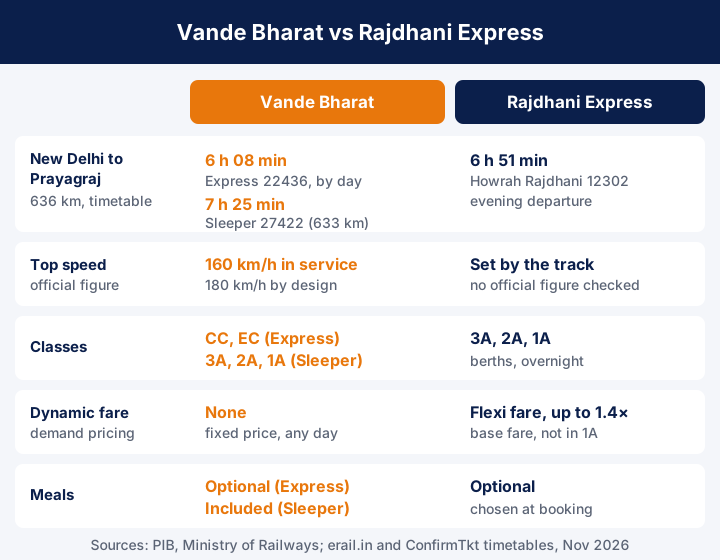
Vande Bharat vs Rajdhani at a glance
| Vande Bharat Express | Vande Bharat Sleeper | Rajdhani Express | |
|---|---|---|---|
| Runs | Mostly by day | Overnight | Overnight |
| Classes | CC and EC (seats) | 3A, 2A, 1A (berths) | 3A, 2A, 1A (berths) |
| Design speed | 180 km/h | 180 km/h | — |
| Maximum operating speed | 160 km/h | — | — |
| Dynamic fare | None | None | Flexi fare, up to 1.4 × base |
| Meals | Optional, chosen at booking | Included in the fare | Optional, chosen at booking |
| RAC tickets | No (seats) | No | — |
| Tatkal | Yes, CC and EC | No | — |
| Train type | Self-propelled trainset | Self-propelled trainset | Coaches pulled by a locomotive |
The Vande Bharat speed figures come from the Ministry of Railways, which describes the Vande Bharat trains in service as having a “design speed of 180 kmph and maximum operating speed of 160 kmph” Source: PIB, 25 July 2025. The Sleeper’s 180 km/h design speed is in the Ministry’s launch note Source: PIB, 1 January 2026. We have not filled in a top speed for the Rajdhani because we did not find a current official figure for it. Cells marked “—” are the ones we could not confirm.
Which is faster, Vande Bharat or Rajdhani?
Top speed is the wrong number to compare. Every stretch of track in India has its own speed limit, and a train may not exceed it whatever it was built for. So the useful test is the scheduled time between the same two stations. We found two corridors where a Vande Bharat and a Rajdhani share the same stops.
New Delhi to Kanpur and Prayagraj
The Howrah Rajdhani 12302 and the New Delhi–Varanasi Vande Bharat trains use the same line out of New Delhi, through Kanpur Central and Prayagraj Jn.
| From New Delhi | Vande Bharat Express 22436 | Vande Bharat Sleeper 27422 | Howrah Rajdhani 12302 |
|---|---|---|---|
| Departs New Delhi | 06:00 | 21:40 | 16:50 |
| Kanpur Central (441 km) | 4 h 8 min | 5 h 5 min | 4 h 40 min |
| Prayagraj Jn (636 km) | 6 h 8 min | 7 h 25 min | 6 h 51 min |
On this line the Vande Bharat Express is the fastest: 32 minutes quicker than the Rajdhani to Kanpur and 43 minutes quicker to Prayagraj. Its average from New Delhi to Prayagraj works out to about 104 km/h, against about 93 km/h for the Rajdhani.
The Vande Bharat Sleeper is the slowest of the three on this stretch, which its timetable measures as 633 km to Prayagraj. It is timed for a full night on board, not for the shortest run: it leaves New Delhi at 21:40 and reaches Varanasi at 07:10, a 758 km trip in 9 hours 30 minutes. The Rajdhani carries on beyond Prayagraj to Howrah and covers 1,449 km in 17 hours 5 minutes, an average of about 85 km/h. Timetables: erail 12302 and ConfirmTkt 12302, checked 12 November 2026, against our checked timetables for 22436 and 27422.
Mumbai Central to Surat and Vadodara
The Mumbai Rajdhani 12951 and the Mumbai Central–Ahmedabad Vande Bharat 22961 both leave Mumbai Central in the afternoon and stop at Surat and Vadodara.
| From Mumbai Central | Vande Bharat Express 22961 | Mumbai Rajdhani 12951 |
|---|---|---|
| Departs Mumbai Central | 15:45 | 17:00 |
| Surat (263 km) | 2 h 53 min | 2 h 43 min |
| Vadodara Jn (392 km) | 4 h 22 min | 4 h 6 min |
Here the Rajdhani is faster, by 10 minutes to Surat and 16 minutes to Vadodara. The Vande Bharat stops at Borivali and Vapi on the way to Surat, and the Rajdhani is timed for a long run to New Delhi (1,384 km, arriving 08:32). Timetables: erail 12951 and ConfirmTkt 12951, checked 12 November 2026.
New Delhi to Patna
On a third corridor, New Delhi to Patna, a PTI report quoted IRCTC timings for a festival-special Vande Bharat Chair Car (02252) of 12 hours 55 minutes, against 11 hours 28 minutes for the Tejas Rajdhani, which officials called the fastest train on the route Source: PTI via ThePrint, 9 November 2026. That special leaves New Delhi at 08:35 and reaches Patna at 21:30 Source: Business Today, 15 October 2026. It is a seasonal special, not a regular Vande Bharat, so it is not in our trains list.
So, is Vande Bharat faster than Rajdhani? On one shared line yes, on another no. The Vande Bharat train can accelerate harder (0 to 100 km/h in about 52 seconds for the second generation Source: PIB, 9 September 2022), but the track, the number of stops and the timetable decide the journey time. More on that in Vande Bharat speed and fastest routes.
Comfort and classes: seats against berths
This is the biggest practical difference. The Vande Bharat Express is a Chair Car train: you sit for the whole trip in AC Chair Car (CC) or Executive Chair Car (EC). That suits a journey of a few hours by day. The CC vs EC guide explains the two seat layouts and the price gap.
The Rajdhani Express has berths in AC 3-tier (3A), AC 2-tier (2A) and AC First Class (1A), and it runs overnight, so you sleep through most of the journey. Officials made the same point when the Delhi–Patna Vande Bharat special drew complaints: they said the Vande Bharat Chair Car is meant mainly for intercity routes of up to about 700 km Source: PTI via ThePrint, 9 November 2026.
The Vande Bharat Sleeper is the like-for-like rival to the Rajdhani. It has the same three classes, 3A, 2A and 1A. The Ministry of Railways lists its features as ergonomically designed berths with improved cushioning, automatic doors with vestibules, better suspension and noise reduction, Kavach, CCTV in all coaches and an emergency talk-back unit Source: PIB, 1 January 2026. The first Sleeper train has 16 coaches: 11 of 3A, 4 of 2A and 1 of 1A, for about 823 passengers (same source). The Ministry also lists jerk-free semi-permanent couplers and sealed gangways Source: PIB, 11 March 2026.
The design difference behind this is that both Vande Bharat trains are self-propelled trainsets with no separate engine, while a Rajdhani is a set of coaches pulled by a locomotive. The Ministry calls the Vande Bharat a shift away from locomotive-hauled trains Source: PIB backgrounder.
There are only three Vande Bharat Sleeper pairs today: Howrah–Kamakhya, Mumbai CSMT–SMVT Bengaluru and New Delhi–Varanasi. On most Rajdhani routes, there is no Vande Bharat Sleeper to choose. See the Vande Bharat Sleeper guide for all three.
Vande Bharat vs Rajdhani fare
The three trains are priced in three different ways.
Vande Bharat Express: fixed fare with separate charges
The Vande Bharat Express fare is a base fare plus reservation, superfast, GST and an optional meal charge. On IRCTC on 11 November 2026, New Delhi to Varanasi on 22436 cost:
| Class | With meal | Of which meal | Without meal |
|---|---|---|---|
| CC | ₹1,835 | ₹363 | ₹1,472 |
| EC | ₹3,385 | ₹418 | ₹2,967 |
There is no dynamic part. The Ministry of Railways says “there is no plan to implement dynamic fares in Vande Bharat Chair Car or Vande Bharat Sleeper trains” Source: PIB, 11 February 2026. See the Vande Bharat ticket price page for every route we have checked.
Vande Bharat Sleeper: per-km, all inclusive
The Sleeper is priced per kilometre with food included. The Ministry gives a rate of ₹2.40 per km in 3A before GST, calls it an “all inclusive fare” and says the train has no RAC tickets Source: PIB, 11 March 2026. The rates reported for the other classes are ₹3.10 in 2A and ₹3.80 in 1A, and every ticket is charged for at least 400 km Source: The Quint, 12 January 2026. On IRCTC on 11 November 2026, New Delhi to Varanasi on 27422 (758 km) cost:
| Class | Fare, food and GST included |
|---|---|
| 3A | ₹1,915 |
| 2A | ₹2,470 |
| 1A | ₹3,030 |
Cancelling is stricter than on most trains. Gazette notification G.S.R. 41(E) of 16 January 2026, applied by Railway Board Commercial Circular 08 of 2026, deducts 25% of the fare more than 72 hours before departure, 50% from 72 to 8 hours, and gives no refund after that. Full rules: Vande Bharat cancellation charges.
Rajdhani: base fare plus flexi fare
The Rajdhani has a flexi fare. When it began on 9 September 2016 for Rajdhani, Duronto and Shatabdi trains, the base fare rose 10% for every 10% of berths sold, up to 1.5 times the base fare, and AC First Class was left out Source: Scroll, 7 September 2016. From 15 March 2019, the cap was cut to 1.4 times, the scheme was dropped on some low-occupancy trains, and discounts of up to 20% were added for trains still less than 70% full close to departure Source: Business Today, 4 January 2019.
In practice, that means a Rajdhani ticket costs less when you book early on a quiet train and more when it is nearly full. The scheme is still working: on 11 November 2026, IRCTC added ₹284 of dynamic fare to the Howrah–Puri Shatabdi in CC (see Vande Bharat vs Shatabdi).
We could not check a regular Rajdhani fare on IRCTC for the routes above, so we do not quote one. The one current figure we found is from the Delhi–Patna route in the festive season, when AC 3-tier on the Tejas Rajdhani cost ₹2,545 and CC on the Vande Bharat special cost ₹2,615 Source: PTI via ThePrint, 9 November 2026. So on that route, a Rajdhani berth was cheaper than a Vande Bharat seat, and faster.
What this means for the price you pay
- On the Vande Bharat Express and Sleeper, the price stays the same however full the train is. Only availability changes.
- On the Rajdhani, the same berth can cost noticeably more on a busy date. Compare both totals on IRCTC on your date before you decide.
- On the Sleeper, short trips cost more per km than the headline rate because of the 400 km minimum.
Food: included, optional, or your choice
- Vande Bharat Express: the meal is optional and chosen at booking. On 22436, the meal added ₹363 in CC and ₹418 in EC.
- Vande Bharat Sleeper: food is part of the fare. The Ministry says trains serve regional food, with Assamese dishes from Guwahati and Bengali dishes from Kolkata on the first route Source: PIB, 1 January 2026.
- Rajdhani: meals are now chosen at booking online, and an IRCTC official said a one-litre Rail Neer bottle is still given to every passenger whether or not they take meals Source: NewsX, 9 December 2025.
When you compare fares, compare like with like: the Sleeper price already includes food, so set it against a Rajdhani fare with meals.
Booking rules that differ
- Tatkal: the Vande Bharat Express has Tatkal in CC and EC; the Vande Bharat Sleeper has none. See Vande Bharat Tatkal.
- RAC: the Sleeper has no RAC tickets, so you either have a berth or wait (Ministry of Railways, PIB, 11 March 2026, linked above).
- Concessions: the Ministry says there is no concession in fare on Vande Bharat trains, though four seats per Chair Car train are kept for Divyangjan passengers Source: PIB, 11 February 2026.
- Booking opens 60 days ahead at 08:00 IST for the Vande Bharat Sleeper. Use the booking date calculator for your date.
Which should you book?
Book the Vande Bharat Express if:
- you are travelling by day and the trip is a few hours, up to about 700 km;
- it is faster on your stretch, as it is from New Delhi to Kanpur and Prayagraj;
- you want a fixed fare that does not rise as seats sell.
Book the Rajdhani if:
- you want to sleep through a long journey and there is no Vande Bharat Sleeper on the route;
- you book early, when the flexi fare is still low;
- it is faster on your stretch, as it is from Mumbai Central to Surat and Vadodara;
- the Vande Bharat is full or the timing does not suit you.
Book the Vande Bharat Sleeper if:
- it runs on your route (Howrah–Kamakhya, Mumbai–Bengaluru or New Delhi–Varanasi);
- you want food included and a fare that does not change with demand;
- your trip is long enough that the 400 km minimum does not inflate the price;
- you are sure of your dates, because cancelling costs at least 25%.
How to compare the trains on your own date
- Search your two stations and date on IRCTC and note every Vande Bharat and Rajdhani that appears.
- Compare the scheduled journey time between your stations, not the train’s top speed. Use the official schedule enquiry or our time table tool.
- Compare the total fare for the class you want, with meals on both sides.
- Check availability on both, then decide on departure time: an evening Rajdhani saves a hotel night, a morning Vande Bharat gives you the afternoon at your destination.
Vande Bharat vs Rajdhani FAQs
Which is faster, Vande Bharat or Rajdhani? It depends on the route. From New Delhi to Prayagraj, the Vande Bharat Express 22436 takes 6 hours 8 minutes and the Howrah Rajdhani 12302 takes 6 hours 51 minutes. From Mumbai Central to Vadodara, the Mumbai Rajdhani 12951 takes 4 hours 6 minutes and the Vande Bharat 22961 takes 4 hours 22 minutes.
What is the top speed of Vande Bharat compared with Rajdhani? The Vande Bharat has a maximum operating speed of 160 km/h and a design speed of 180 km/h, according to the Ministry of Railways. We did not find a current official top speed for the Rajdhani, and in both cases the speed limit of the track sets the real speed.
Is the Vande Bharat Sleeper better than the Rajdhani? It has the same classes (3A, 2A, 1A), newer coaches, food included and no dynamic fare. But it runs on only three routes, has no Tatkal and has strict cancellation rules, and on New Delhi–Prayagraj it was slower than the Rajdhani: 7 hours 25 minutes against 6 hours 51 minutes.
Is Vande Bharat costlier than Rajdhani? The Vande Bharat fare is fixed, while the Rajdhani fare rises with demand up to 1.4 times the base fare. On the Delhi–Patna route in the 2026 festive season, a PTI report put the Vande Bharat special at ₹2,615 in CC and the Tejas Rajdhani at ₹2,545 in 3A.
Does Rajdhani have a dynamic fare? Yes. Rajdhani is covered by the flexi fare scheme, started in September 2016 and capped at 1.4 times the base fare from March 2019. Vande Bharat Chair Car and Sleeper trains have no dynamic fare.
Is food included in Rajdhani and Vande Bharat? On the Vande Bharat Sleeper, yes, food is in the fare. On the Vande Bharat Express and the Rajdhani, the meal is optional and chosen at booking.
Does the Vande Bharat Express have sleeper berths like the Rajdhani? No. The Vande Bharat Express has CC and EC seats only. Berths are on the separate Vande Bharat Sleeper.
Will Vande Bharat replace the Rajdhani? We have not found an official statement that Rajdhani trains will be withdrawn. On New Delhi–Prayagraj, the Howrah Rajdhani, two daytime Vande Bharat pairs and the Vande Bharat Sleeper all run in November 2026.
Related
- What is Vande Bharat Express?
- Vande Bharat vs Shatabdi
- Vande Bharat vs Tejas
- Vande Bharat vs Namo Bharat vs Amrit Bharat
- Vande Bharat vs other trains
- Vande Bharat speed and fastest routes
- Vande Bharat ticket price
- CC vs EC
- All Vande Bharat trains and all routes
- Delhi – Varanasi Vande Bharat Sleeper
Sources
Vande Bharat fares for 22436 and 27422: IRCTC fare enquiry, 11 November 2026. Vande Bharat timetables for 22436, 22961 and 27422: erail.in and ConfirmTkt, 11 November 2026. Rajdhani timetables: erail 12302, ConfirmTkt 12302, erail 12951, ConfirmTkt 12951, 12 November 2026. Speed: PIB, 25 July 2025; PIB, 9 September 2022; PIB backgrounder. Sleeper features, coaches and food: PIB, 1 January 2026. Sleeper fare and no RAC: PIB, 11 March 2026; The Quint, 12 January 2026. No dynamic fare and no concessions: PIB, 11 February 2026. Sleeper refunds: Gazette G.S.R. 41(E), 16 January 2026, and Railway Board Commercial Circular 08 of 2026. Flexi fare: Scroll, 7 September 2016; Business Today, 4 January 2019. Delhi–Patna fares and times: PTI via ThePrint; Business Today, 15 October 2026. Rajdhani meals: NewsX, 9 December 2025. Report a correction.
Keep reading about Vande Bharat
Vande Bharat vs Other Trains: Which Is Better?
Is Vande Bharat better than other trains? Vande Bharat Express compared with Rajdhani, Shatabdi, Tejas, Amrit Bharat, Namo Bharat, the bullet train and a normal express: speed, classes, meals, fares and which to book.
Vande Bharat vs Shatabdi: Which Is Faster and Cheaper?
Vande Bharat vs Shatabdi compared on the same routes: journey time, real IRCTC fares, base fare rule, dynamic fare and meals. Which is faster, which is cheaper, and which to book.
Vande Bharat vs Tejas Express: Which Is Faster and Better?
Vande Bharat vs Tejas Express on the same routes: journey times, top speed, seating, meals, dynamic fares and IRCTC Tejas delay compensation. Includes the difference between IRCTC Tejas, Indian Railways Tejas and Tejas Rajdhani.
Vande Bharat Ticket Price: Fares by Route
Vande Bharat Express ticket prices from IRCTC for popular routes in CC and EC, with and without meals. Full fare breakdown, Sleeper fares, and why Vande Bharat costs more than Shatabdi.