
Vande Bharat Train Review: Is It Worth It?
Verdict: the Vande Bharat Express is worth booking when you want the fastest daytime train on a route and are happy to pay a higher, fixed fare for it. It is usually quicker than Shatabdi on the same stations, every seat has a charging point, and the fare never rises with demand. Its weak points are the food, where complaints have led to fines on caterers of Vande Bharat trains, a base fare set 1.4 times higher than Shatabdi, and high demand that makes seats hard to get. The new Vande Bharat Sleeper is good value overnight, but it runs on only three routes and has strict refund rules.
On this page
- Vande Bharat review scorecard
- Speed: the strongest part of the Vande Bharat Express
- Comfort and seats
- Food: the weakest part of the review
- Cleanliness and toilets
- Punctuality
- Price
- Booking
- Vande Bharat Express (Chair Car) review
- Vande Bharat Sleeper train review
- Who should book a Vande Bharat train, and who should not
- Vande Bharat review FAQs
- Sources
This Vande Bharat train review is not one person’s trip report. A single journey tells you about one train on one day: one caterer, one coach, one delay. Instead, this review judges each part of the Vande Bharat train on evidence: our checked timetables for all 168 Vande Bharat services, IRCTC fares, Ministry of Railways replies in Parliament, and what passengers have reported in aggregate through official channels and the press. Where no good evidence exists, as with Vande Bharat punctuality, we say so instead of guessing.
Vande Bharat review scorecard
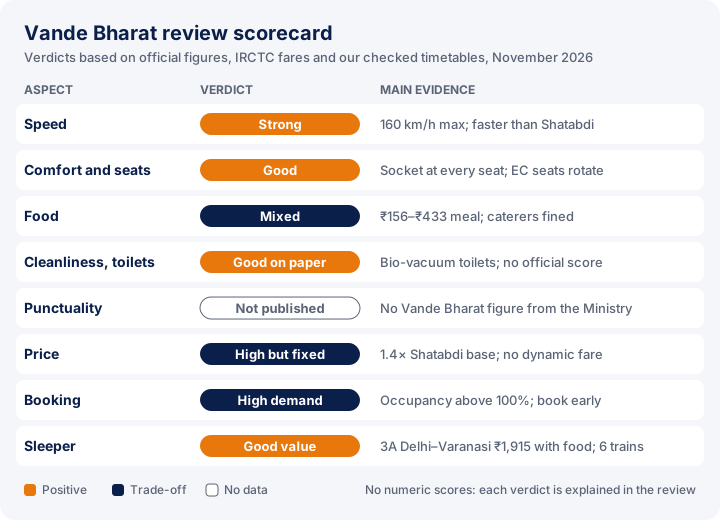
| Aspect | Verdict | The evidence |
|---|---|---|
| Speed | Strong | 160 km/h maximum in service. Faster than Shatabdi on both routes we compared. Average over a whole journey is 72.5 km/h across 162 Chair Car trains. |
| Comfort and seats | Good | CC 3+2, EC 2+2 with rotating seats. Recline increased on trains from September 2023. Charging point and reading light for every seat. No way to choose a window seat. |
| Food | Mixed | Optional, ₹156 to ₹433 per person on the trains we checked. Complaints about food on two Vande Bharat trains in 2026 led to fines on the caterers. |
| Cleanliness and toilets | Good on paper | Bio-vacuum toilets and a divyangjan toilet at each end. No official cleanliness score for Vande Bharat exists, so we cannot rate it further. |
| Punctuality | Not published | The Ministry gives network punctuality (77.12% for Mail and Express trains in 2024-25), not a Vande Bharat figure. |
| Price | High but fixed | Base fare 1.4 times Shatabdi in CC. No dynamic fare: ₹0 on every Vande Bharat fare we checked. |
| Booking | In high demand | Occupancy above 100% in official figures. CC waiting lists are common; EC is often easier. |
| Sleeper | Good value, few routes | 3A from New Delhi to Varanasi cost ₹1,915 with food. Only 6 trains, no Tatkal, and 25% is lost even on an early cancellation. |
We have not given marks out of ten, because there is no honest way to turn evidence like “food complaints are common” into a number. Each verdict is explained below.
Speed: the strongest part of the Vande Bharat Express
The Ministry of Railways gives the Vande Bharat Express a design speed of 180 km/h and a maximum operating speed of 160 km/h Source: PIB, 25 July 2025. The second-generation train goes from 0 to 100 km/h in about 52 seconds Source: PIB, 9 September 2022, which matters on routes with many stops.
The number that decides your day is the average speed, stops included. Across all 162 Vande Bharat Chair Car trains in our timetables, that average is 72.5 km/h. The slowest train averages 54.2 km/h and the fastest, 22229 Mumbai CSMT–Madgaon, averages 98.7 km/h over 765 km in 7 hours 45 minutes. So a Vande Bharat train is not a bullet train, and on a slow or busy line its average drops well below its top speed. The full ranking is in Vande Bharat speed and fastest routes.
Against older trains on the same stations, the Vande Bharat train still wins. On Howrah–Puri, 22895 takes 6 hours 50 minutes, about an hour less than the Shatabdi on the same route, and on Chennai–Mysuru, 20607 takes 6 hours 30 minutes, half an hour less than the Shatabdi. The detail is in Vande Bharat vs Shatabdi, and comparisons with Rajdhani, Tejas and others are in Vande Bharat vs other trains.
Verdict: strong. Speed is the main reason to book a Vande Bharat Express, and the timetables back it up.
Comfort and seats
A Vande Bharat Chair Car train has two classes. AC Chair Car (CC) has 78 seats in a normal coach in a 3+2 layout, and 44 in each driving coach at the ends. Executive Chair Car (EC) has 52 seats per coach in a 2+2 layout, and the seats rotate to face the direction of travel. A 16-coach train carries 1,128 passengers. The full layout is on the Vande Bharat seat map.
The seats have been changed in response to passengers. When nine new Vande Bharat trains started on 24 September 2023, the Railways said the recline angle had gone up from 17.31 to 19.37 degrees, cushion hardness had been optimised, footrests made longer and the charging points under the seats easier to reach. The Railways said these changes followed passenger feedback. Trains built before then may not have every change.
What every passenger gets, according to the Ministry of Railways: a mobile charging socket at every seat Source: PIB, 2 August 2023, a personal reading light for every seat Source: PIB factsheet, 15 February 2022, automatic plug doors, CCTV in all coaches, emergency talk-back units and the Kavach train protection system Source: PIB, 23 July 2026.
IRCTC allots seats automatically, so you cannot choose a window seat, and there is no official seat-numbering chart. On the 3-seat side of a CC row, one passenger always gets the middle seat. On-board Wi-Fi, where it exists, is stored video content, not internet. See Vande Bharat facilities.
Verdict: good. CC is comfortable for a day trip of up to about eight hours; EC is noticeably roomier but costs about 1.8 to 1.9 times the CC fare.
Food: the weakest part of the review
Food on the Vande Bharat Express Chair Car is optional. You choose a meal or No Food when you book on IRCTC, and the meal price is added to the fare. On the trains we checked on IRCTC on 11 November 2026, the catering charge ran from ₹156 in CC on Mumbai CSMT–Madgaon (22229) to ₹433 in EC on Howrah–New Jalpaiguri (22301). On Howrah–Puri the CC meal is ₹363 of a ₹1,485 fare, about a quarter of what you pay. The Vande Bharat food guide has the full list.
Food is also where the penalties on record come from. The Railway Minister told the Rajya Sabha in July 2025 that passengers made 6,645 complaints about food quality on trains in 2024-25, and that fines were imposed in 1,341 cases Source: ThePrint, 26 July 2025. The reply covered IRCTC catering in general and did not give a separate Vande Bharat count.
Two cases on Vande Bharat trains in 2026 led to penalties:
- After a passenger complaint about the food on the Patna–Tatanagar Vande Bharat Express (21896) on 15 March 2026, Indian Railways fined IRCTC ₹10 lakh and the catering service provider ₹50 lakh, and ordered the provider’s contract to be ended Source: India TV, 25 March 2026.
- After a complaint about food on the Banaras–New Delhi Vande Bharat Express in August 2026, IRCTC fined the catering licensee ₹2 lakh and the base-kitchen food safety agency ₹20,000 Source: All India Radio News, 20 August 2026.
The Vande Bharat cases on record concern particular trains and caterers, and the menu differs from train to train, so one bad report does not describe every Vande Bharat train. The practical answer is to check your train’s menu on the IRCTC menu and rates site and, if you are unsure, book with No Food. You can add a meal later through Opt Meal on IRCTC, and on board you can buy ready-to-eat food until 9 pm. If something is wrong, complain on Rail Madad or helpline 139 while you are still on the train.
Verdict: mixed. The meal is convenient but adds up to a quarter of the fare, and quality depends heavily on the caterer.
Cleanliness and toilets
Vande Bharat trains have bio-vacuum toilets, and each Chair Car train has a toilet for passengers with disabilities in the driving coach at each end Source: PIB backgrounder, January 2026. The AC units have UV-C disinfection, and toilets have aerosol fire detection and suppression Source: PIB, 23 July 2026.
We looked for an official measure of how clean Vande Bharat coaches and toilets are in service and did not find one. Individual complaints appear on social media, as they do for every train, but these do not tell you how often a problem happens. So this review rates the equipment, not the day-to-day cleaning. If a toilet is dirty or blocked on your trip, report it through Rail Madad or helpline 139 with your train and coach number while you are still on board.
Verdict: good on paper. Modern, sealed toilets; no published data on how well they are kept.
Punctuality
The Ministry of Railways publishes punctuality for Mail and Express trains as a whole: 77.12% in 2024-25 and about 80% from April to October 2025 Source: Devdiscourse (PTI), 3 December 2025. We found no official punctuality figure for Vande Bharat trains on their own, so we do not claim one.
Two problems on the line have been reported to Parliament:
- Cattle on the track. The Railway Minister told the Lok Sabha in December 2022 that Vande Bharat trains had been involved in 68 cases of hitting animals since 1 June 2022 Source: Swarajya, December 2022. In April 2025 he told the Lok Sabha that such cases had dropped significantly after about 900 km of track was fenced Source: Ritam, 2 April 2025.
- Stone pelting. In July 2023 the Minister told the Lok Sabha that stone pelting had caused ₹55.60 lakh of damage to Vande Bharat trains since 2019, that 151 people had been arrested, and that no passenger had lost their life or belongings as a result Source: ThePrint (PTI), 26 July 2023. In March 2025 he reported 7,971 stone-pelting incidents on trains including Vande Bharat from 2023 to February 2025, with 4,549 arrests Source: OrissaPOST, 19 March 2025.
To know how your own train usually runs, check its recent running history on NTES before you book, and see PNR and running status. If a Vande Bharat train is very late, the TDR and late-train refund guide explains what you can claim.
Verdict: not published. We will update this section if the Ministry releases a Vande Bharat punctuality figure.
Price
The Ministry of Railways sets the Vande Bharat base fare at 1.4 times Shatabdi in CC and 1.3 times in EC Source: PIB factsheet, 15 February 2022. On IRCTC on 11 November 2026, these were the full-route fares, one adult, General quota, meal included:
| Train | Route | Distance | CC | EC |
|---|---|---|---|---|
| 22961 | Mumbai Central – Ahmedabad | 491 km | ₹1,385 | ₹2,505 |
| 22895 | Howrah – Puri | 502 km | ₹1,485 | ₹2,665 |
| 22229 | Mumbai CSMT – Madgaon | 765 km | ₹1,625 | ₹3,145 |
| 22436 | New Delhi – Varanasi | 771 km | ₹1,835 | ₹3,385 |
Fares change with official revisions, so confirm on IRCTC before you pay. More routes are in Vande Bharat ticket price.
The higher base fare is partly offset by one rule in the passenger’s favour: the Vande Bharat has no dynamic fare. The Ministry says there is no plan to add one Source: PIB, February 2026, and every Vande Bharat fare in our data showed a dynamic fare of ₹0. On Howrah–Puri the same day, the Shatabdi 12277 carried ₹284 of dynamic fare and cost ₹1,410 in CC with a meal, only ₹75 less than the Vande Bharat. Without meals, the Vande Bharat was slightly cheaper.
Is Vande Bharat worth the price? On busy days, often yes, because Shatabdi’s dynamic fare closes most of the gap. On quiet days the Shatabdi or an ordinary express is cheaper, and if time does not matter, that is the better buy.
Verdict: high but fixed.
Booking
Demand is the main obstacle to travelling on a Vande Bharat Express. The government’s January 2026 backgrounder put Vande Bharat occupancy at 102.01% in 2024-25 and 105.03% in 2025-26 up to June 2025, and said the trains had carried more than 7.5 crore passengers Source: PIB backgrounder, January 2026. In December 2025 the Railway Minister told the Lok Sabha that overall occupancy was “around 100 per cent” Source: Devdiscourse (PTI), 3 December 2025.
For you, this means booking early. Chair Car trains have no RAC, Tatkal is available in CC and EC, and on the trains we checked in November 2026 EC waiting lists were much shorter than CC. See the Vande Bharat booking guide and the waiting list guide.
Verdict: in high demand.
Vande Bharat Express (Chair Car) review
The Chair Car Vande Bharat Express is a fast, modern day train with a price to match. Of the 168 Vande Bharat services in our timetables, 162 are Chair Car trains, and almost all run by day. It works best on routes of about 400 to 800 km, where it saves the most time and you arrive the same day: Mumbai–Goa in 7 hours 45 minutes, New Delhi–Varanasi in 8 hours on 22436, Mumbai Central–Ahmedabad in 5 hours 30 minutes on 22961.
Its strengths are speed, a predictable fare, clean modern coaches and power at every seat. Its weaknesses are the cost of the meal, uneven food quality, no seat choice and the difficulty of getting a confirmed CC ticket at short notice. Running days matter as well: most Vande Bharat trains do not run one day a week (22895 Howrah–Puri does not run on Thursday, 22229 Mumbai–Madgaon not on Friday), and a few run only once a week, such as 21896 Patna–Tatanagar on Sunday. Check your train on the route list.
Vande Bharat Sleeper train review
The Vande Bharat Sleeper is a different train with its own numbers, rules and fares. Six run as of November 2026, in three pairs: Howrah–Kamakhya (27575/27576), Mumbai CSMT–SMVT Bengaluru (27651/27652) and New Delhi–Varanasi (27421/27422). Each runs six nights a week, with berths in 3A, 2A and 1A. A train has 16 coaches, 11 in 3A, 4 in 2A and 1 in 1A, for about 823 passengers Source: PIB, 1 January 2026. Official lists add berth reading lights with USB-A and USB-C ports Source: PIB, 30 October 2026 and a hot-water shower in First AC.
What works. The value is good. On IRCTC on 11 November 2026, New Delhi to Varanasi on 27422 cost ₹1,915 in 3A, ₹2,470 in 2A and ₹3,030 in 1A, with food included in the fare Source: PIB, January 2026. That 3A berth is only ₹80 more than a CC seat with a meal on the daytime 22436 (₹1,835), and you travel overnight instead of losing a day. The timings suit a night’s sleep: 27422 leaves New Delhi at 21:40 and reaches Varanasi at 07:10, and 27421 leaves Varanasi at 20:50 and reaches New Delhi at 06:10. There is no dynamic fare and no separate catering charge.
What does not. There are only three routes, and two of them started in November 2026, so the record is short and we have not found official occupancy or complaint figures for the Sleeper. There is no Tatkal. The refund rule is strict: 25% of the fare is lost if you cancel more than 72 hours before departure, 50% until 8 hours before, and nothing comes back after that. Every ticket is charged for at least 400 km. Railway Board rules say confirmed tickets only, but IRCTC showed waiting-list numbers on 27422 in November 2026, so check the status before you pay. The long routes are slow on average: 27651 takes 15 hours 50 minutes for 1,114 km, and the Howrah–Kamakhya pair takes 14 hours for 966 km with 13 stops in between.
Sleeper verdict: good value, few routes. If your journey is on one of the three routes and your dates are fixed, the Sleeper is worth booking. Full timetables are on the Vande Bharat Sleeper page.
Who should book a Vande Bharat train, and who should not
Book it if you:
- want the fastest daytime train between two cities and need to arrive the same day;
- travel on a busy date, when the Shatabdi’s dynamic fare makes it nearly as costly;
- need to work or charge devices on the way: every seat has a socket;
- travel overnight on New Delhi–Varanasi, Howrah–Kamakhya or Mumbai–Bengaluru and want a berth with food included (the Sleeper).
Skip it, or compare first, if you:
- are on a tight budget and time does not matter: an ordinary express or a quiet-day Shatabdi will usually cost less;
- care most about food: book No Food and carry your own, or choose another train;
- need to book at the last minute in CC, when waiting lists are common (try EC or Tatkal);
- might change plans on the Sleeper, where even an early cancellation costs a quarter of the fare;
- travel a short hop on the Sleeper, which charges at least 400 km.
Vande Bharat review FAQs
Is Vande Bharat worth it? For a fast daytime trip of a few hundred kilometres, usually yes: it is faster than Shatabdi on the routes we compared and its fare does not rise with demand. If cost matters more than time, a Shatabdi on a quiet day or an ordinary express is cheaper.
What do passengers complain about most on Vande Bharat? No official breakdown of Vande Bharat complaints is published. The complaints that have led to official action are about food: fines on caterers of the Patna–Tatanagar and Banaras–New Delhi Vande Bharat trains in 2026 followed passenger complaints. Across IRCTC catering, passengers made 6,645 food quality complaints in 2024-25, according to the Railway Minister.
What do passengers praise about the Vande Bharat Express? No official survey of what passengers like is published. The clearest sign of approval is demand: official occupancy was above 100% in 2024-25, and the trains carried more than 7.5 crore passengers by December 2025.
Is the Vande Bharat Express on time? No separate official punctuality figure for Vande Bharat trains has been published. Check your train’s recent running on NTES before you book.
Is the Vande Bharat Sleeper train good? For value, yes: 3A from New Delhi to Varanasi cost ₹1,915 with food on IRCTC in November 2026. But there are only six Sleeper trains, no Tatkal, and strict cancellation rules.
Is Vande Bharat better than Shatabdi? It is faster on the routes we compared and has no dynamic fare, but its base fare is 1.4 times Shatabdi’s in CC. See Vande Bharat vs Shatabdi.
Is Vande Bharat safe? It has Kavach, CCTV in every coach, automatic doors and emergency talk-back units. Stone pelting has damaged Vande Bharat trains, but in 2023 the Railway Minister told Parliament that no passenger had lost their life as a result.
Should I take the meal on Vande Bharat? Check your train’s menu and meal charge first. On Howrah–Puri the CC meal is about a quarter of the fare. You can book No Food and add a meal later through Opt Meal.
Sources
- Timetables, distances, average speeds and running days: our checked timetables for all 168 Vande Bharat services, each checked against erail.in and ConfirmTkt in November 2026.
- Fares and catering charges: IRCTC fare enquiry, one adult, General quota, 11 November 2026. Confirm on IRCTC before booking.
- Ministry of Railways via PIB: speed, 25 July 2025 · acceleration, 9 September 2022 · facilities, 23 July 2026 · charging points, 2 August 2023 · fare rule and reading lights, factsheet 15 February 2022 · no dynamic fare, February 2026 · occupancy, January 2026 · Sleeper coaches, 1 January 2026 · Sleeper food, January 2026 · Sleeper berths, 30 October 2026
- Parliament replies as reported: food complaints, ThePrint · punctuality and occupancy, Devdiscourse · stone pelting 2023, ThePrint · stone pelting 2025, OrissaPOST · cattle 2022, Swarajya · cattle 2025, Ritam
- Catering penalties: India TV, 25 March 2026 · All India Radio News, 20 August 2026
Found a mistake? Report a correction.
Keep reading about Vande Bharat
Vande Bharat Express Route List
All 81 Vande Bharat Chair Car routes and 3 Sleeper routes in India, with train numbers and station codes, grouped by state, plus Bengaluru timings. Updated November 2026.
How to Book a Vande Bharat Ticket on IRCTC
How to book a Vande Bharat Express train ticket on IRCTC: when booking opens (60 days, 08:00 IST), choosing CC or EC, meals, Tatkal at 10:00, Sleeper booking rules and tips for a confirmed seat.