Why Vande Bharat Was Launched: Vision, Targets and Results
The Vande Bharat train was launched to give India a faster, more comfortable day train for intercity routes of a few hundred kilometres, built in India at a lower price than an imported train. It began in 2018 as “Train 18”, a successor to the Shatabdi Express designed at the Integral Coach Factory (ICF) in Chennai. Its vision has since grown into a national plan: about 800 trainsets by 2030 and around 4,500 by 2047, the year India aims to become a developed nation. Progress is real but slower than the targets. In November 2026 there were 85 Vande Bharat routes with 170 train services, while the 400 new trains promised in the 2022 Budget have not appeared in any official count.
On this page
- Vande Bharat vision in brief
- The problems the Vande Bharat train was meant to solve
- Make in India: how ICF built the Vande Bharat train
- Vande Bharat targets and plans announced over time
- What the Vande Bharat Express has achieved, and what it has not
- Challenges and criticism
- What the Vande Bharat vision means for passengers
- Why Vande Bharat train was launched FAQs
- Related guides
- Sources
For the dates of each launch, read the Vande Bharat history; for what the train is and how it works, see what is Vande Bharat Express.
Vande Bharat vision in brief
| Question | Short answer | Source |
|---|---|---|
| Why was Vande Bharat launched? | Demand for shorter travel times and better comfort on intercity routes, mainly medium-distance ones | PIB backgrounder, 16 January 2026 |
| Which train was it meant to follow? | The Shatabdi Express, started in 1988 | The Quint, 29 October 2018 |
| Who designed it? | ICF Chennai, in-house, in 18 months | PIB, 14 February 2019 |
| What did it cost? | About ₹100 crore for the prototype, “less than half of global prices” | The Quint; PIB, 14 February 2019 |
| How Indian is it? | Around 90% localisation for ICF-built trainsets | PIB backgrounder |
| Biggest target so far | 400 new-generation trains in three years (Budget, 1 February 2022) | PIB, 1 February 2022 |
| Long-term vision | About 800 trainsets by 2030, around 4,500 by 2047 | PIB backgrounder |
| Where it stands (November 2026) | 85 routes, 170 services, 3 of them Sleeper routes | Our checked timetables |
The problems the Vande Bharat train was meant to solve
The Ministry of Railways sums up the reason for the Vande Bharat train in one line: “The requirement for Vande Bharat emerged from growing demand for reduced travel time and enhanced onboard comfort on inter-city routes, particularly on medium-distance corridors” Source: PIB backgrounder, 16 January 2026. Official statements from 2018 onwards point to five aims.
1. The Shatabdi Express needed a successor
India’s premium day train, the Shatabdi Express, started in 1988, and the Rajdhani Express in 1969 Source: PIB backgrounder. Both are trains of separate coaches pulled by a locomotive.
When Train 18 rolled out of ICF in October 2018, Railway Ministry officials told IANS that it would replace the existing Shatabdi Express fleet once it was running Source: The Quint, 29 October 2018. Press reports of the time called it a successor to the “30-year-old Shatabdi Express”, which by then ran on more than 20 routes Source: DNA, 24 October 2018.
The age refers to the Shatabdi service, which began in 1988. We did not find an official figure for the age of the Shatabdi coaches in use in 2018, so this page does not give one.
What the record shows is that the Vande Bharat Express was planned as the next step after the Shatabdi, with the same kind of seats (AC Chair Car and Executive Chair Car) and better facilities. The Prime Minister’s Office said exactly that before the first run: the train “has travel classes like Shatabdi Train but with better facilities” Source: PIB, 14 February 2019.
The replacement has not happened in full. Shatabdi trains still run in 2026, for example 12277 Howrah–Puri, which runs on the same route as the Vande Bharat 22895. Our Vande Bharat vs Shatabdi guide compares the two on shared routes.
2. Shorter journey times
The second aim was speed. The first Vande Bharat Express was rated at 160 km/h and was timed to cover New Delhi to Varanasi in 8 hours Source: PIB, 14 February 2019. The Ministry now says Vande Bharat trains cut journey time “up to 45 percent on several corridors”, and that the New Delhi–Varanasi time of about eight hours is “around 40 to 50 percent faster than earlier services on the route” Source: PIB backgrounder.
The first route still runs to the 2019 plan. Train 22436 leaves New Delhi at 06:00 and reaches Varanasi Jn at 14:00, 771 km in exactly 8 hours, with only two stops in between, Kanpur Central and Prayagraj Jn. That is an average of 96.4 km/h, among the fastest of all 170 Vande Bharat services.
3. Faster acceleration with motors spread along the train
A Vande Bharat train has no separate engine. The Ministry calls it a “self-propelled semi-high-speed trainset” and says it “marks a shift from conventional locomotive-hauled trains to integrated train systems” Source: PIB backgrounder. With traction motors under coaches along the whole train, more wheels drive the train, so it picks up speed and slows down faster than a single locomotive pulling a rake. The Ministry says the trains are “designed for faster acceleration and deceleration”, and that this is what allows the cut in journey time.
The second-generation train, which entered service in September 2022, goes from 0 to 100 km/h in about 52 seconds and weighs 392 tonnes against 430 tonnes for the first version Source: PIB, 9 September 2022. On Indian routes, where trains often slow down for stations, curves and speed restrictions, the time saved while regaining speed adds up over a whole trip.
A driving cab at each end also means no engine has to be moved round the train at the terminus. The Ministry adds a practical benefit of putting electrical equipment under the floor: a 16-coach Vande Bharat seats 1,128 passengers, which it called “much more than the conventional Shatabdi rake of equal number of coaches” Source: PIB, 14 February 2019.
4. Passenger comfort and safety
The fourth aim was a better ride. The Ministry’s list of reasons for introducing Vande Bharat trains, given in Parliament in 2023, begins “With a view to provide better travel experience to the passengers”, and lists Kavach train protection, automatic plug doors, sealed gangways, reclining seats, a charging socket at every seat, CCTV in all coaches and a special toilet for passengers with disabilities Source: PIB, 2 August 2023.
The 2019 release also mentioned insulation meant to keep heat and noise low, and bio-vacuum toilets in every coach Source: PIB, 14 February 2019. The full list is on Vande Bharat facilities.
Energy use was part of the same design. The first train had regenerative braking, which the PMO said “can save up to 30% of electrical energy” Source: PIB, 14 February 2019, and the second version has air-conditioning that is about 15% more energy-efficient Source: PIB, 9 September 2022.
5. Lower cost and less dependence on imports
The fifth aim was to build a modern trainset in India for much less than buying one abroad. This is the Make in India part of the Vande Bharat mission.
Make in India: how ICF built the Vande Bharat train
The Vande Bharat Express was designed and built by the Integral Coach Factory (ICF) in Chennai, a production unit of Indian Railways. According to the Prime Minister’s Office, ICF did the design, computer modelling and system integration in-house, “working with a large number of suppliers”, in 18 months, and “the major systems of the train have been designed and built in India” under the Make in India programme Source: PIB, 14 February 2019.
What the Vande Bharat train cost
Only a few cost figures have been published, and they come from different sources:
- Prototype: about ₹100 crore. ICF General Manager Sudhanshu Mani told PTI the prototype cost “nearly Rs 100 crore” to build and that later trains would cost less Source: The Quint, 29 October 2018. A figure of about ₹97 crore was also reported at the time; we found no official cost in a Ministry release (see the history guide).
- An imported equivalent: about ₹180 crore, by ICF’s estimate. ICF’s public relations officer told The Quint that “if the train had been made by a foreign company, the total cost would have come to around Rs 180 crore” Source: The Quint. This is ICF’s own comparison, not an audited figure.
- Less than half of global prices. The PMO said the train matched global standards “and yet costing less than half of global prices” Source: PIB, 14 February 2019.
- ₹1,343.72 crore spent on manufacture by mid-2023. In August 2023 the Railway Minister told the Lok Sabha that total funds used to manufacture Vande Bharat trains were ₹1,343.72 crore, when 50 services were running Source: PIB, 2 August 2023. The reply does not say how many trainsets that sum covers, so we do not divide it into a cost per train.
For a later comparison, the tender for 100 aluminium-bodied Vande Bharat trainsets with sleeping berths drew a lowest bid of ₹151 crore per trainset from Alstom, against about ₹140 crore that Indian Railways was aiming to pay Source: Railway Gazette, 15 August 2024. Those are different trains with a maintenance contract attached, so the figure cannot be compared directly with the 2018 prototype.
How much of Vande Bharat is made in India?
The government puts it at around 90% localisation for trainsets built at ICF, “in line with the Make in India initiative” Source: PIB backgrounder. It is not 100%. In 2024, ICF received the National Energy Conservation Award for building Vande Bharat trainsets, according to the same backgrounder. The what is Vande Bharat guide has more on who builds the train today, including BEML for the Sleeper.
Vande Bharat targets and plans announced over time
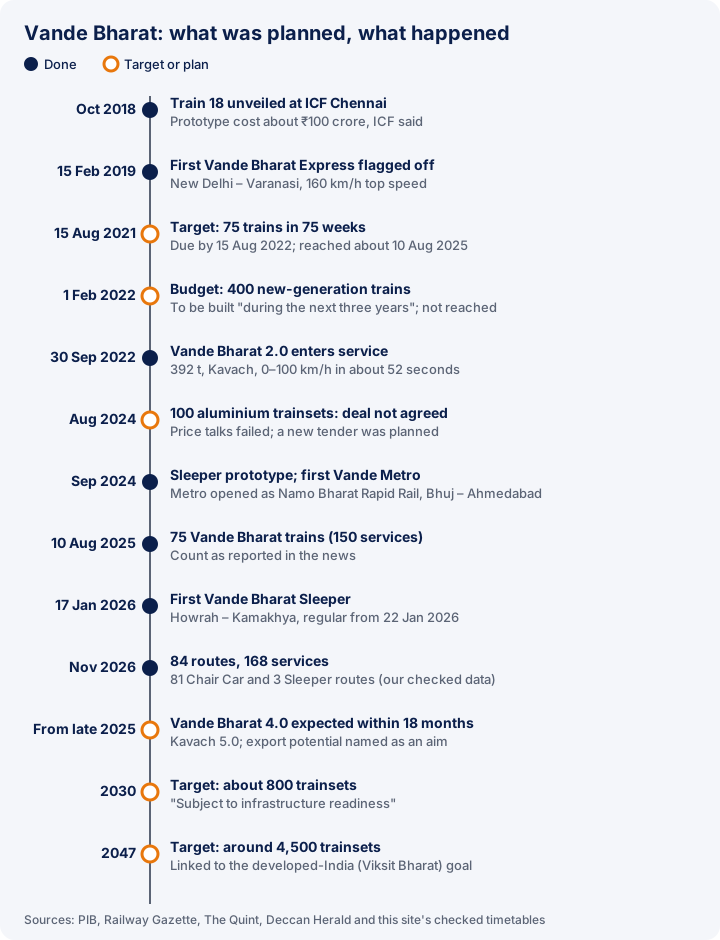
The vision for the Vande Bharat train has been restated many times, each time with a bigger number. This is every major target we could trace to an official or reputable source, with the result so far.
| Date announced | Target or plan | Due | What happened | Source |
|---|---|---|---|---|
| October 2018 | Train 18 to replace the Shatabdi fleet | No date | Shatabdi trains still run in 2026 | The Quint |
| 15 August 2021 | 75 Vande Bharat trains in 75 weeks | 15 August 2023 | 75 trains (150 services) reported on 10 August 2025 | PIB; Deccan Herald |
| 1 February 2022 | 400 new-generation Vande Bharat trains | “During the next three years” | Not reached; 85 routes and 170 services in November 2026 | PIB |
| By June 2023 | 100 aluminium-bodied Vande Bharat trainsets with sleeping berths | Not given | Deal with the lowest bidder not agreed by August 2024; new tender planned | Railway Gazette |
| By September 2024 | Vande Metro for short commuter routes | Not given | First one opened as Namo Bharat Rapid Rail, 16 September 2024 | PIB |
| By September 2024 | Vande Bharat Sleeper | Not given | Prototype September 2024; first service January 2026; 3 routes by November 2026 | PIB |
| Late 2025 | Vande Bharat 4.0, with export potential | Within 18 months | Not yet in service | PIB backgrounder |
| January 2026 | About 800 trainsets | 2030 | In progress | PIB backgrounder |
| January 2026 | Around 4,500 trainsets | 2047 | Long-term vision | PIB backgrounder |
75 Vande Bharat trains in 75 weeks (2021)
In his Independence Day speech on 15 August 2021, the Prime Minister said that “during these 75 weeks of the Amrit Mahotsav of Independence, 75 Vande Bharat trains will connect every corner of the country” Source: PIB, 15 August 2021. The PIB text of the speech says the Amrit Mahotsav, which began on 12 March 2021, would continue until 15 August 2023. By 21 July 2023, 50 Vande Bharat trains had been introduced (PIB, 26 July 2023).
According to news reports, the count of 75 trains, or 150 services, was reached on 10 August 2025 Source: Deccan Herald. That is about two years after the target date. The history guide has the growth in service numbers year by year.
400 new-generation Vande Bharat trains (Budget 2022)
In the Union Budget on 1 February 2022, the Finance Minister said that “four hundred new-generation Vande Bharat Trains with better energy efficiency and passenger riding experience will be developed and manufactured” during the next three years Source: PIB, 1 February 2022. Three years from that speech ran to early 2025.
This is where the plan and the actual numbers differ most. In November 2026, our checked timetables list 85 Vande Bharat routes and 170 services: 82 Chair Car pairs and 3 Sleeper pairs. The Ministry’s own count on 23 July 2026 was 162 Chair Car services and 2 Sleeper services Source: PIB, 23 July 2026.
A service is one train in one direction, and the number of physical trainsets is different again, since a single trainset can work more than one service and spare sets are kept for maintenance. We found no official count of trainsets built. But no published figure, whether services, pairs or routes, comes near 400 new trains.
Aluminium trains
Part of the 2022 plan was a lighter train with an aluminium body instead of the stainless steel used so far. Indian Railways tendered for 100 such trainsets, 16 coaches each with sleeping berths.
Alstom was confirmed as the lowest bidder in June 2023, but the two sides failed to agree on price, only two bids had been received, and “a replacement call for tenders is now planned” Source: Railway Gazette, 15 August 2024. We found no official notice of a new contract, so as of November 2026 no aluminium Vande Bharat is in service.
Vande Metro, now Namo Bharat Rapid Rail
The Vande Bharat platform was also meant to serve short commuter trips. The first “Vande Metro”, between Bhuj and Ahmedabad, was renamed Namo Bharat Rapid Rail and inaugurated on 16 September 2024 Source: PIB, 16 September 2024. By the end of 2025, two such services ran, Bhuj–Ahmedabad and Jaynagar–Patna Source: PIB Year End Review, 28 December 2025. These are separate trains from the Vande Bharat Express; see Vande Bharat vs Namo Bharat vs Amrit Bharat.
Vande Bharat Sleeper
The Chair Car Vande Bharat suits trips of a few hundred kilometres in daylight. For overnight travel the plan was a Sleeper version. A prototype was unveiled at BEML in Bengaluru on 1 September 2024, and the first Vande Bharat Sleeper, Howrah–Kamakhya, was flagged off on 17 January 2026 Source: PIB, 17 January 2026.
The Ministry expected it to cut the Howrah–Guwahati trip from about 17 hours on the Saraighat Express to about 14 hours Source: PIB backgrounder. In our data, 27575 Howrah–Kamakhya runs 966 km in 14 hours. By November 2026, two more Sleeper routes had started: New Delhi–Varanasi (27421/27422) and Mumbai CSMT–SMVT Bengaluru (27651/27652). See the Vande Bharat Sleeper guide.
Vande Bharat 4.0 and export ambitions
The Ministry describes Vande Bharat 4.0 as the next model, with Kavach 5.0, better seats and toilets, and finer interior finish. It says the next-generation trainsets are meant to meet India’s own needs “but also to demonstrate export potential”, and links future plans to “dedicated high-speed corridors capable of supporting speeds of up to 350 kmph”. Version 4.0 is “expected within 18 months from late 2025” Source: PIB backgrounder. We found no confirmed export order for a Vande Bharat train, so export remains an aim, not a result.
Vande Bharat 2047: the long-term vision
The largest numbers tie the train to India’s goal of becoming a developed nation, Viksit Bharat, by 2047. The Ministry’s January 2026 backgrounder opens with that goal and sets two fleet targets: “operating about 800 Vande Bharat trainsets by 2030, subject to infrastructure readiness and manufacturing capacity”, and a fleet “envisioned to scale to around 4,500 trainsets” by 2047 Source: PIB backgrounder, 16 January 2026.
The 2030 target is conditional, and the earlier 75-train and 400-train targets were both missed. The backgrounder does not say how many of the 4,500 trainsets would be Chair Car, Sleeper or other versions, or what routes they would run on.
What the Vande Bharat Express has achieved, and what it has not
Achieved
- People use it. By December 2025, Vande Bharat services had carried more than 7.5 crore passengers in 274 districts. Occupancy was 102.01% in 2024-25 and 105.03% in 2025-26 up to June 2025 Source: PIB backgrounder. In December 2025 the Railway Minister told the Lok Sabha that overall occupancy was “around 100 per cent” Source: Devdiscourse (PTI), 3 December 2025.
- A wide network. 85 routes and 170 services across 23 states and union territories, from Jammu Tawi–Srinagar in the north to Chennai–Nagercoil in the south, according to our route list.
- Faster on the right routes. The best Vande Bharat trains are fast over a whole trip: 22436 New Delhi–Varanasi averages 96.4 km/h, and 20171 Rani Kamalapati–Hazrat Nizamuddin 92.1 km/h.
- An Indian design that kept evolving. Version 2.0 in 2022, the Sleeper in 2026 and a 4.0 version in development, all from the same platform, with around 90% localisation.
- No dynamic fare. The Ministry says there is no plan to add dynamic pricing to Vande Bharat Source: PIB, February 2026.
Not achieved yet
- The 400-train target. Not met by early 2025, and still not met in November 2026.
- The 75-in-75-weeks target on time. Met about two years late.
- 160 km/h running on most routes. Across 160 Chair Car trains (the four on Konkan Railway are left out), the average speed including stops is 71.9 km/h, with a range of 54 to 96 km/h, from our speed guide. Only 27 Chair Car trains average 80 km/h or more. We do not give an average speed for trains on the Konkan Railway, because the distance listed for them is a fare distance, inflated by 40% Source: Konkan Railway.
- Aluminium trainsets. Tender not concluded.
- Exports. No order found.
- Full replacement of the Shatabdi. Shatabdi trains still run on several routes.
Challenges and criticism
Speed below design on many routes
The Vande Bharat train is designed for 180 km/h and allowed up to 160 km/h, “subject to route readiness” Source: PIB backgrounder. Most track is not ready. In 2025, only 21.8% of Indian Railways track, 23,010 km, was cleared for 130 km/h or more; 56.6% was cleared for 110 to 130 km/h, and 21.6% was below 110 km/h Source: PIB, 25 July 2025. The Ministry itself says average speed “depends upon the geometry of the track, stoppages enroute, maintenance work in the section etc.” (same source).
The slowest Vande Bharat trains show the gap. Gorakhpur–Patliputra (26502) averages 54.2 km/h over 384 km, and Jammu Tawi–Srinagar (26401) 55.7 km/h on a mountain line. On those routes the train cannot do much more than an ordinary express, because the track and the number of stops set the pace.
Track upgrades still needed
The plan to make faster running possible is older than most Vande Bharat routes. In August 2019 the Cabinet approved raising speeds on the Delhi–Mumbai and Delhi–Howrah routes to 160 km/h, with a 2022-23 target Source: PIB, Delhi–Howrah; Source: PIB, Delhi–Mumbai. By July 2026, Kavach 4.0 had been commissioned on 2,490 route km, on routes including parts of those corridors Source: PIB, 23 July 2026.
We have not found an official notice that Vande Bharat trains now run at 160 km/h along the full length of either route. Where track is cleared, the difference shows: the Bhopal–Delhi pair 20171/20172 uses the Delhi–Agra line and averages 92.1 km/h over 700 km.
Fares
The Vande Bharat Express costs more than the train it was meant to replace. The Ministry set the base fare at 1.4 times the Shatabdi base fare in CC and 1.3 times in EC Source: PIB factsheet, 15 February 2022. In practice the gap can be small because Vande Bharat has no dynamic fare while Shatabdi does.
On IRCTC for travel on 11 November 2026, Howrah to Puri in CC with a meal cost ₹1,485 on the Vande Bharat 22895 (base fare ₹983) and ₹1,410 on the Shatabdi 12277 (base fare ₹708 plus ₹284 dynamic fare). Check current fares on the ticket price page.
Stone pelting and cattle hits
Two problems outside the train’s control have damaged it. In July 2023 the Railway Minister told the Lok Sabha that stone pelting had caused ₹55.60 lakh of damage to Vande Bharat trains since 2019 and that 151 people had been arrested, with no passenger losing their life Source: ThePrint (PTI), 26 July 2023. In March 2025 he reported 7,971 stone-pelting incidents on trains including Vande Bharat from 2023 to February 2025, with 4,549 arrests Source: OrissaPOST, 19 March 2025.
Animals on the track are the other problem. The Minister told the Lok Sabha in December 2022 that Vande Bharat trains had hit animals in 68 cases since 1 June 2022 Source: Swarajya, December 2022. In April 2025 he said such cases had dropped sharply after about 900 km of track was fenced Source: Ritam, 2 April 2025.
Targets announced faster than they are met
Every dated target so far has slipped: 75 trains by August 2023 arrived in August 2025, 400 trains by early 2025 have not arrived, and the aluminium tender stalled over price. Treat the 2030 and 2047 numbers as stated aims, not schedules.
What the Vande Bharat vision means for passengers
- Book early. With occupancy around 100%, seats on popular Vande Bharat trains sell out. Bookings open 60 days ahead on IRCTC; the booking guide explains how, and the waiting list guide covers what to do if you miss out.
- Expect the biggest time saving on long routes with few stops. Routes of about 400 to 800 km, such as Mumbai–Goa, New Delhi–Varanasi and Mumbai Central–Ahmedabad, show what the train was designed for. On short routes with many stops, compare the timetable with other trains before paying more.
- Compare with the Shatabdi on shared routes. Because Shatabdi fares can include a dynamic fare and Vande Bharat fares do not, the price gap may be small on the day you travel.
- For overnight trips, look at the Sleeper. Three Vande Bharat Sleeper routes ran in November 2026, with berths in 3A, 2A and 1A and food included.
- More trains are planned, but not dated. The 2030 target of about 800 trainsets would mean many more routes, but no official list of future routes or dates exists. New services are listed on our updates page when they start.
Why Vande Bharat train was launched FAQs
Why was the Vande Bharat train launched? To meet demand for shorter travel times and better comfort on intercity routes, mainly medium-distance ones, according to the Ministry of Railways. It was planned as a successor to the Shatabdi Express and built in India at a lower cost than an imported train.
What is the vision of Vande Bharat? The Ministry’s stated vision is to make Vande Bharat a main part of passenger rail modernisation, with about 800 trainsets by 2030 and around 4,500 by 2047, linked to India’s goal of becoming a developed nation by 2047.
What is the main objective of the Vande Bharat Express? Faster, safer and more comfortable intercity travel. The government says the trains cut journey times by up to 45% on several corridors.
Was Vande Bharat meant to replace the Shatabdi Express? Yes. In 2018, Railway Ministry officials said Train 18 would replace the Shatabdi fleet. Shatabdi trains still run in 2026, so the replacement is not complete.
How is Vande Bharat linked to Make in India? ICF Chennai designed and built it in-house in 18 months, and the government says ICF trainsets have around 90% localisation. The PMO said the first train cost less than half of global prices.
How much did the first Vande Bharat cost? About ₹100 crore for the prototype, according to ICF’s general manager in 2018. ICF estimated an imported equivalent at about ₹180 crore.
What was the 400 Vande Bharat trains plan? In the Budget on 1 February 2022, the Finance Minister announced 400 new-generation Vande Bharat trains to be developed and manufactured over the next three years. By November 2026 there were 170 Vande Bharat services on 85 routes, so the target has not been met.
What is Vande Bharat 2047? The long-term target of around 4,500 Vande Bharat trainsets by 2047, set out by the Ministry of Railways in January 2026.
What is the future of Vande Bharat? More Sleeper trains, Vande Bharat 4.0 (expected within 18 months from late 2025), and a fleet target of about 800 trainsets by 2030. The Ministry also names export potential as an aim, but no export order has been announced.
Why does Vande Bharat not run at its full speed? Because most Indian track is not cleared for it. In 2025 only 21.8% of track was cleared for 130 km/h or more. The average Vande Bharat Chair Car train runs at 71.9 km/h including stops.
Related guides
- Vande Bharat history
- What is Vande Bharat Express?
- Vande Bharat speed and fastest routes
- Vande Bharat vs Shatabdi
- Vande Bharat review
Sources
PIB: 14 Feb 2019 · 15 Aug 2021 · 1 Feb 2022, Budget · 15 Feb 2022 factsheet · 9 Sep 2022 · 2 Aug 2023 · 16 Sep 2024 · 25 Jul 2025 · 28 Dec 2025 · 16 Jan 2026 backgrounder · 17 Jan 2026 · Feb 2026 · 23 Jul 2026 · Delhi–Howrah and Delhi–Mumbai speed upgrades.
Reported: The Quint, 29 Oct 2018 · DNA, 24 Oct 2018 · Railway Gazette, 15 Aug 2024 · Deccan Herald · Devdiscourse · ThePrint · OrissaPOST · Swarajya · Ritam. Timings, distances and averages: our checked timetables (data/trains.csv, 11 November 2026). Fares: IRCTC, checked 11 November 2026. Report a correction.
Keep reading about Vande Bharat
Vande Bharat Express History and Milestones
The first Vande Bharat Express (Train 18) was flagged off on 15 February 2019 from New Delhi to Varanasi. History up to the first Sleeper in January 2026.
What Is Vande Bharat Express?
What is Vande Bharat train? India's semi-high-speed train built by ICF Chennai: how it works, how many run, CC and EC, speed, food, Sleeper and booking.
Vande Bharat Speed: Top Speed, Average Speed and Fastest Routes
Vande Bharat top speed is 160 km/h in service and 180 km/h by design. Average speeds by train, the fastest routes and India's fastest train.
Vande Bharat vs Shatabdi: Which Is Faster and Cheaper?
Vande Bharat vs Shatabdi on the same routes: journey time, real IRCTC fares, the base fare rule, dynamic fare and meals, and which to book.