
Vande Bharat Express Without Ticket Fine and Penalty Rules
If you are found on a Vande Bharat Express without a valid ticket, you pay the fare for the journey plus an excess charge equal to that fare, and the excess charge is at least ₹500. On a Vande Bharat that almost always works out to about double the ticket price: roughly ₹2,944 for New Delhi to Varanasi in Chair Car (CC) and ₹5,934 in Executive Chair Car (EC).
On this page
- How the fine is calculated
- Real Vande Bharat examples
- Can you board a Vande Bharat without a reserved ticket?
- What happens when the TTE finds you without a ticket
- What if you cannot or will not pay?
- Honest mistake or fraud: Section 137 vs Section 138
- What if you tell the TTE first?
- Lost ticket, phone dead or no ID
- How to avoid the fine
- Vande Bharat without ticket FAQs
- Related guides and tools
- Sources
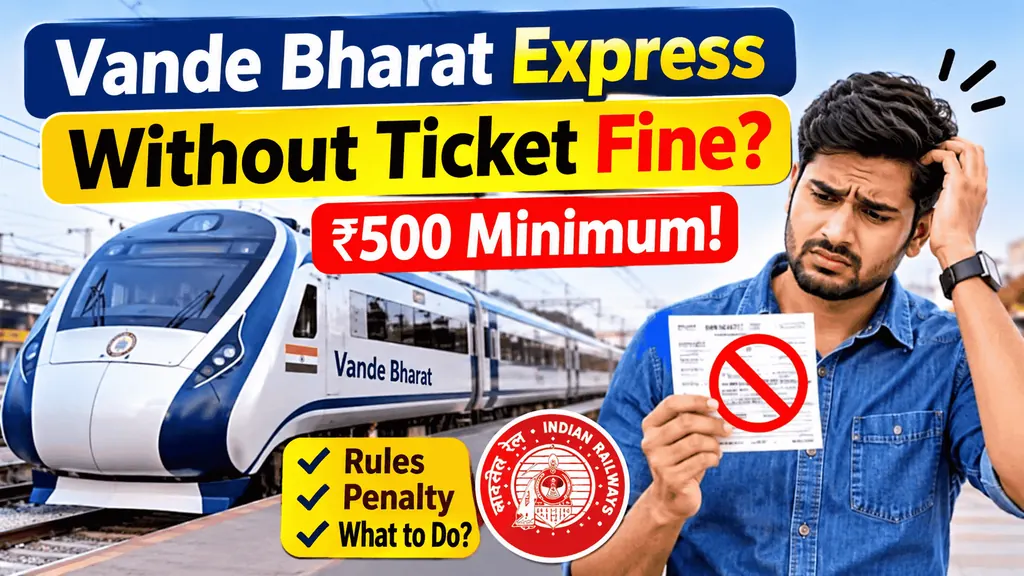
The ₹500 minimum was ₹250 until 19 June 2026, which is why older websites still quote ₹250. There is no separate penalty schedule for Vande Bharat trains. The same Railways Act rules apply as on any other train. What makes Vande Bharat different is that the fares are high and every seat is reserved, so the bill is larger and a general or platform ticket does not cover you.
How the fine is calculated
The rule is in Section 138 of the Railways Act, 1989. A passenger found without a proper ticket, beyond the station on the ticket, or in a higher class than the ticket allows, pays two things:
- The fare for the distance travelled (or the difference in fare, for a higher class or extra distance).
- An excess charge equal to that same fare or difference, or ₹500, whichever is more.
So the total is the fare plus the larger of the fare and ₹500. In practice:
| Fare for the journey | Excess charge | Total payable |
|---|---|---|
| ₹300 | ₹500 (the minimum) | ₹800 |
| ₹500 | ₹500 | ₹1,000 |
| ₹1,200 | ₹1,200 | ₹2,400 |
| ₹2,000 | ₹2,000 | ₹4,000 |
The ₹500 minimum only decides the amount when the fare is below ₹500. Vande Bharat fares are rarely that low: even the shortest trips in our fare data, such as Gomati Nagar to Ayodhya Dham (127 km), cost ₹550 in CC. So on a Vande Bharat, expect the excess charge to equal the fare, and the total to be about twice what the ticket would have cost.
Why ₹500 and not ₹250? The Jan Vishwas (Amendment of Provisions) Act, 2026 received the President’s assent on 7 April 2026 and replaced “two hundred and fifty rupees” in Section 138 with “five hundred rupees or the charges notified by the Central Government”.
The Railways Act changes came into force on 19 June 2026 through notification S.O. 3255(E) of the Ministry of Railways (Gazette copy). Some reports say 20 June; the notification is dated 19 June. The words “or the charges notified” mean the government can set a different figure later, so check this page’s date.
Work it out for your own trip: the Vande Bharat fine calculator takes your train, stations and situation (no ticket, higher class, past your station or someone else’s ticket) and fills in the IRCTC fare where we have it.
Real Vande Bharat examples
These use fares from IRCTC’s fare enquiry, checked on 11 November 2026, for one adult in the general quota. We have left out the catering charge, because food is optional and a ticket issued on board would not include a meal you did not order. The exact amount the TTE writes may differ by a few rupees, because of rounding and how GST is treated on the excess ticket, so read these as close estimates rather than official quotes.
| Train and journey | Class | Fare without food | Excess charge | About what you pay |
|---|---|---|---|---|
| 22436 New Delhi (NDLS) – Varanasi (BSB), 771 km | CC | ₹1,472 | ₹1,472 | ₹2,944 |
| 22436 New Delhi – Varanasi | EC | ₹2,967 | ₹2,967 | ₹5,934 |
| 22229 Mumbai CSMT – Madgaon (MAO), 765 km | CC | ₹1,469 | ₹1,469 | ₹2,938 |
| 22895 Howrah (HWH) – Puri, 502 km | CC | ₹1,122 | ₹1,122 | ₹2,244 |
| 27422 Sleeper, New Delhi – Varanasi, 758 km | 3A | ₹1,915 | ₹1,915 | ₹3,830 |
The fare breakdown for each train, including the catering charge we left out, is on the Vande Bharat ticket price page, and the fare calculator gives the fare for other station pairs.
Sitting in EC with a CC ticket
The same rule covers travel in a higher class. On 22436 New Delhi–Varanasi, the EC fare without food is ₹2,967 and the CC fare is ₹1,472, a difference of ₹1,495. A CC passenger found sitting in EC for the whole journey would pay that difference plus an equal excess charge: about ₹2,990.
That is more than the full CC ticket cost. The coaches look different enough (EC has 2+2 seating and is usually near the middle of the train) that “I sat in the wrong coach” is hard to argue. Our CC vs EC page shows where each class is.
Going past your station
If you stay on beyond the station printed on your ticket, you pay the fare for the extra distance plus an equal excess charge, with the same ₹500 minimum. Because the extra stretch is often short, this is the case where the ₹500 floor usually applies. Staying on for one more stop can cost more than ₹500 even if that stop would have added only ₹150 to your ticket.
Can you board a Vande Bharat without a reserved ticket?
No. Every Vande Bharat Express is fully reserved. There are no general (unreserved) coaches, so there is no ticket you can buy at the counter and then find a seat. This changes several things people assume from other trains.
- A general (unreserved) ticket does not cover a Vande Bharat. It is a ticket for unreserved travel on trains that have unreserved coaches. On a Vande Bharat you would be treated as travelling without a proper ticket.
- A platform ticket is not a journey ticket. It lets you onto the platform to see someone off. Boarding the train with it is the same as having no ticket.
- A ticket for another train does not transfer. A reserved ticket is for one train, one date and one class. If you miss your Shatabdi and jump on the Vande Bharat on the same route, you need a ticket for the Vande Bharat.
- A fully waitlisted e-ticket is not valid after the chart. IRCTC’s rules say such tickets are cancelled automatically when the chart is prepared, passengers holding them “are not allowed to board the train”, and if found travelling they are treated as travelling without a ticket (IRCTC waitlisted e-ticket scheme). Chair Car Vande Bharat trains have no RAC, so a ticket is either confirmed or waitlisted; the waiting list guide explains how to read it.
- Someone else’s ticket is not yours. A reserved ticket is in the passenger’s name. Using a ticket booked for another person falls under Section 142, which since 2026 means the ticket is forfeited and you pay the fare plus an equal excess charge, minimum ₹500 (Jan Vishwas Act, 2026). If plans change, use the official name-change rules instead.
If you need to travel today and the train shows no seats, look at current booking first. After the chart, empty seats can be sold again, and some zones let you book a Vande Bharat seat up to 15 minutes before departure. The chart preparation time tool tells you when the chart is made for your train.
What happens when the TTE finds you without a ticket
Railway staff check tickets on platforms, on board and at the destination, and they check that you have authority for that particular train and class (Indian Railways Commercial Manual, Chapter V). On a Vande Bharat, ticket checking on board is routine because every seat is allotted: an empty-looking seat on the chart that is occupied stands out.
What usually happens:
- The TTE asks for your ticket and, for an e-ticket, the ID you used to book.
- If you have no valid ticket, the TTE asks where you boarded and where you are going.
- The fare for that distance is worked out, and the excess charge is added.
- You pay, and you get an excess fare ticket (EFT) or receipt. Keep it until you leave the station; it is your proof that you paid.
Where the fare is counted from. If there is doubt about where you got on, the law lets the fare be charged from the station where the train started its journey. If tickets were already checked on the way, it is charged from the station where they were last checked (Section 138). On a long Vande Bharat that matters: someone who boarded 22436 at Kanpur Central but cannot show it may be charged from New Delhi.
A receipt does not give you a seat. Paying the penalty settles what you owe for the journey. It does not entitle you to a particular seat, and on a full train there may be none. If the TTE has a vacant seat, it may be allotted to you; if not, you may have to stand or get off at the next stop.
According to the Commercial Manual, once a passenger pays the amount demanded, no further action should be taken against them.
What if you cannot or will not pay?
Refusing does not make the charge go away. Under Section 138, the railway staff member can take you before the court. Since the 2026 amendment the law says “the competent court having jurisdiction”, instead of naming specific magistrates. The court can order the amount recovered as if it were a fine, and the Act provides for imprisonment of at least 10 days and up to one month if it is still not paid. The 2026 Act changed the court wording but left that default term in place.
That is a court decision, not something the TTE decides on the train. Someone who genuinely cannot pay is not sent to jail on the spot, but they will have to deal with the court and the amount will still be recovered.
Honest mistake or fraud: Section 137 vs Section 138
Most people caught without a ticket fall under Section 138, which deals with travelling without a proper ticket. It does not assume dishonesty. You pay the fare and the excess charge and that is it.
Section 137 is different. It applies to someone who travels without proper authority with the intent to defraud the railway, for example by reusing a ticket that has already been used. The 2026 Act rewrote it. The amount due is the fare plus an equal excess charge, again with a ₹500 minimum.
If that is not paid, the case goes to the court, which can impose imprisonment of up to six months, a fine of up to ₹500, or both (Jan Vishwas Act, 2026). Before 2026, Section 137 carried a fine of up to ₹1,000 as well as the excess charge.
Do not believe posts that say every ticketless passenger is “booked for fraud” or “jailed for six months”. The six-month figure is a court penalty for not paying under the fraud section. Ordinary ticketless travel under Section 138 ends with payment in almost every case.
Sitting in a reserved seat and refusing to move is a separate offence under Section 155. If you occupy a seat reserved for someone else and refuse to leave when told, the 2026 Act sets a penalty of ₹2,000. This is on top of any fare and excess charge for not having a ticket.
What if you tell the TTE first?
If you have boarded without a valid ticket, for example because you ran for the train at the last minute, go to the TTE straight away instead of waiting to be found. Tell them the station where you actually boarded and where you are going, and ask for an excess fare ticket.
We found no rule that waives the excess charge for passengers who come forward on their own, and the Commercial Manual does not make an exception for them. You should expect to pay the same fare plus excess charge.
What reporting does is remove any doubt about where you boarded, so you are charged from the right station and not from the train’s starting point, and it makes clear there was no intent to defraud. On a train with a vacant seat, it also gives the TTE a chance to seat you.
Lost ticket, phone dead or no ID
Lost or forgotten ticket. A lost ticket is not the same as never having bought one. For an e-ticket, the booking is on IRCTC’s records and the TTE’s chart shows your name against the seat, so carrying the ID you booked with is what matters. For a counter ticket, there is a duplicate ticket procedure; ask at the booking office before you travel, because getting a duplicate on board is not always possible.
Phone switched off. An e-ticket does not have to be shown as a printout. Your name on the TTE’s chart, matched with your ID, is normally enough. Keep the SMS from IRCTC, which has the PNR, coach and seat.
No ID. For an e-ticket, carry the original ID you entered while booking. Without it you may have trouble proving the ticket is yours, so treat the ID as part of the ticket.
How to avoid the fine
- Book before you board, on IRCTC or at a reservation counter. Check the train number and date.
- If you are waitlisted on an e-ticket, check the PNR status after the chart. If it is still waitlisted, do not board; the ticket is cancelled and refunded automatically, less a ₹60 clerkage charge plus GST.
- Sit in the class and coach on your ticket. The coach number is on your ticket and on the coach door.
- Get off at the station on your ticket. If you need to go further, ask the TTE before your station.
- Carry the original ID you used to book.
- If something goes wrong, go to the TTE before they come to you.
Vande Bharat without ticket FAQs
What is the fine for travelling without a ticket in Vande Bharat Express? The fare for the journey plus an excess charge equal to the fare, with a minimum excess charge of ₹500. On most Vande Bharat trips that is about twice the ticket price, for example about ₹2,944 New Delhi–Varanasi in CC.
Is the fine ₹500 or ₹1,000? Neither is the whole fine. ₹500 is the minimum excess charge, added on top of the fare. If the fare is ₹500, you pay ₹1,000; if the fare is ₹1,500, you pay ₹3,000.
When did the minimum change from ₹250 to ₹500? On 19 June 2026, when the Railways Act changes in the Jan Vishwas (Amendment of Provisions) Act, 2026 came into force.
Can I travel in Vande Bharat with a general ticket? No. Vande Bharat trains have no unreserved coaches, so a general ticket does not cover them, and you would be charged as travelling without a proper ticket.
Can I buy a Vande Bharat ticket from the TTE after boarding? The TTE can issue an excess fare ticket, but you pay the fare plus the excess charge, not the normal fare, and a seat is not guaranteed.
Can I travel in Vande Bharat with a waiting list ticket? Not with a fully waitlisted e-ticket after the chart. IRCTC cancels it and refunds it, and if you board you are treated as travelling without a ticket.
Is the fine different for CC and EC? The rule is the same, but the amount follows the fare, so the fine in EC is about twice the fine in CC.
What happens if I refuse to pay the railway fine? You can be taken to court. Under Section 138 the court can order the amount recovered and, if it is still not paid, imprisonment of 10 days to one month.
Does the TTE waive the penalty if I report it myself? We found no rule that waives it. Reporting first means you are charged from the right station and shows you were not trying to cheat, but you should expect to pay the fare plus excess charge.
Can I travel in Vande Bharat with a platform ticket? No. A platform ticket only lets you onto the platform. Boarding with it counts as travelling without a ticket.
What happens if the TTE catches me without a ticket? The TTE asks where you boarded and where you are going, works out the fare for that distance, adds an equal excess charge (at least ₹500) and gives you an excess fare ticket once you pay. If you pay, no further action is taken in an ordinary case. If you cannot show where you boarded, the fare can be counted from the station where the train started.
Can I continue my journey after paying the fine? Yes, the excess fare ticket covers you to the destination you paid for. It does not give you a seat, though. On a full Vande Bharat the TTE may have no vacant seat to allot, and you may be asked to get off at the next stop if you cannot be accommodated.
Is the fine the same on other trains? Yes. The fare plus an equal excess charge, minimum ₹500, applies on every Indian train under Section 138 of the Railways Act. The amount is bigger on a Vande Bharat only because its fares are higher.
Is GST added to the fine? The fare part already includes GST in AC classes: the CC fare of ₹1,472 on New Delhi–Varanasi includes ₹71 of GST. Whether 5% GST is also added on the excess charge is something we could not confirm from an official source, so the examples on this page do not add it. If it is charged, it adds about 5% of the excess charge, around ₹74 on that journey. The fine calculator has an option to add it.
Can I travel in Vande Bharat with a ticket for another train? No. A reserved ticket is valid only for the train, date and class printed on it. If you board a Vande Bharat with a ticket for another train, you are charged as travelling without a proper ticket.
What if I miss my Vande Bharat train? Your ticket is not valid on a later train, so do not board the next one with it. Whether you get any money back depends on timing: a confirmed ticket cancelled in the last hours before departure gets no refund, while a fully waitlisted e-ticket is refunded automatically after the chart. See the refund rules, and the TDR guide if you missed it because an earlier train on a linked PNR ran late.
Can I cancel 2 tickets out of 4 on IRCTC? Yes. On IRCTC you can tick only the passengers who are not travelling, and the others keep their seats. Each cancelled passenger is charged separately, so two cancellations cost two cancellation charges. The cancellation charges guide gives the amounts.
What does a Vande Bharat ticket cost? In the IRCTC fares we recorded, a Chair Car ticket costs from ₹550 (Gomati Nagar to Ayodhya Dham, 127 km) to ₹2,160 (Ajni to Pune, 881 km) with the meal, and an Executive Chair Car ticket from ₹1,040 to ₹3,830. See Vande Bharat ticket price for every route.
Related guides and tools
- Vande Bharat booking guide and ticket prices
- Waiting list guide and chart preparation time
- Changing your ticket instead of cancelling
- Vande Bharat fine calculator
Sources
Railways Act, 1989, Section 138 and Section 137 (pre-2026 text; read with the amendments) · Jan Vishwas (Amendment of Provisions) Act, 2026, Act 8 of 2026, Schedule entry 52 (Railways Act): Sections 137, 138, 142 and 155 · Commencement: notification S.O.
3255(E), Ministry of Railways, 19 June 2026 (Gazette copy) · IRCTC waitlisted e-ticket scheme · Indian Railways Commercial Manual, Chapter V (ticket checking; its older minimum amounts are out of date) · Fares: IRCTC fare enquiry, 11 November 2026. This guide explains the rules for passengers and is not legal advice. Read 19 November 2026. Report a correction.
Keep reading about Vande Bharat

Vande Bharat Fine Calculator
What you pay if found without a valid ticket: fare plus excess charge.

Vande Bharat Ticket Price: Fares by Route
Vande Bharat train ticket prices from IRCTC on popular routes in CC and EC, with and without meals, Sleeper fares, and why it costs more than Shatabdi.
Vande Bharat Waiting List and Chart Rules
How the Vande Bharat waiting list works: real WL figures from IRCTC, chart time, GNWL and REGRET, unconfirmed tickets, the confirmed-only Sleeper and tips.
Vande Bharat Chart Preparation Time
When the chart is made for your train.