
Vande Bharat Sleeper vs Chair Car: What Is the Difference?
The Vande Bharat Chair Car is the daytime train with seats in AC Chair Car (CC) and Executive Chair Car (EC). The Vande Bharat Sleeper is the overnight train with berths in AC 3-tier (3A), AC 2-tier (2A) and First AC (1A). They share the name and the design speed of 180 km/h, but they are booked, priced and refunded under different rules.
On this page
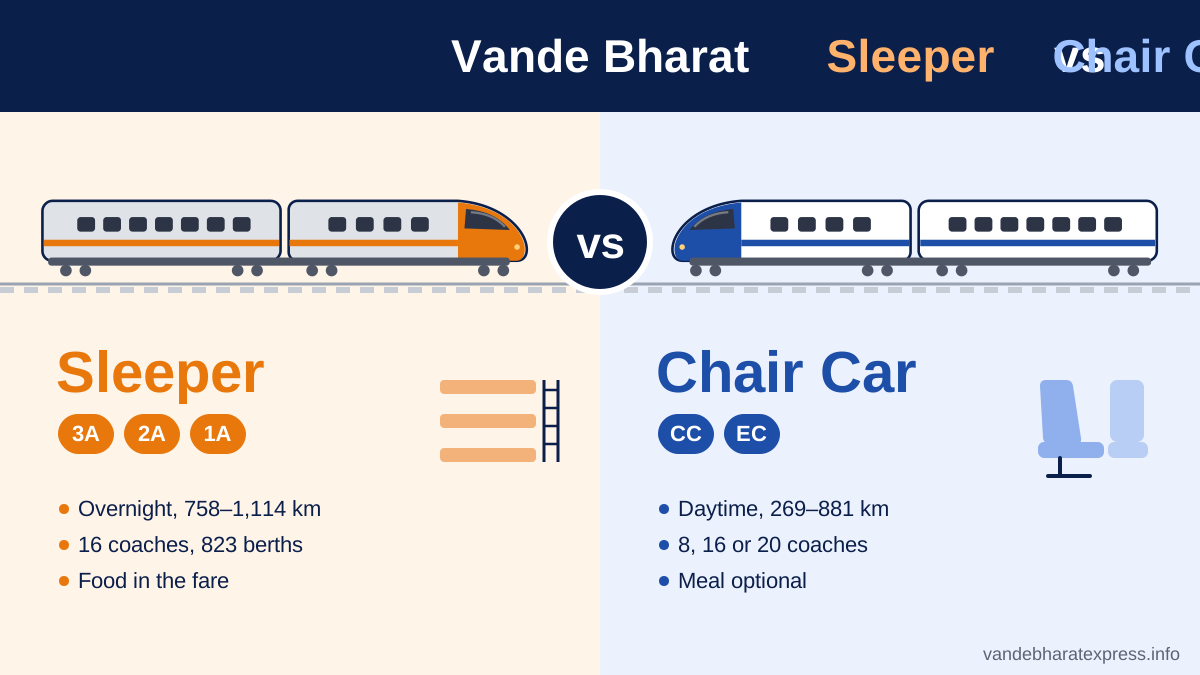
In November 2026 our checked timetables list 164 Chair Car services (82 pairs of trains) and 6 Sleeper services on three routes. So when someone says “Vande Bharat”, they almost always mean the Chair Car. The Sleeper is newer: the first one, Howrah–Kamakhya, began on 22 January 2026 (PIB), nearly seven years after the first Chair Car train left New Delhi for Varanasi on 15 February 2019 (PIB, 23 July 2026).
Sleeper vs Chair Car at a glance
| Vande Bharat Sleeper | Vande Bharat Chair Car | |
|---|---|---|
| When it runs | Overnight: leaves 18:15–21:40, arrives 06:10–12:00 | Mostly by day |
| Classes | 3A, 2A and 1A berths | CC and EC seats |
| Coaches | 16 | 8, 16 or 20 |
| Capacity | 823 berths | 530, 1,128 or 1,440 seats |
| Services | 6 (3 routes) | 164 (82 pairs) |
| Route length | 758–1,114 km | 269–881 km |
| Design speed | 180 km/h | 180 km/h (160 km/h in service) |
| Food | Included in the fare | Optional, chosen at booking |
| Fare | Per km, all-inclusive | Base fare plus separate charges |
| Minimum fare | Charged for at least 400 km | No minimum distance |
| Tatkal | No | Yes, in CC and EC |
| RAC | No | No |
| Early cancellation | 25% of the fare deducted | Flat charge of ₹180 (CC) or ₹240 (EC) plus GST |
| Train numbers | Start with 27 | Usually start with 20, 22 or 26 |
The counts, times and distances come from our checked timetables; each rule is sourced in its own section.
Berths against seats
A Vande Bharat Sleeper has 16 coaches: 11 in 3A with 611 berths, 4 in 2A with 188 and 1 in 1A with 24, for 823 berths in all (India TV; PIB, January 2026). There are no seats to book, no non-AC Sleeper Class and no general coach. The Sleeper berth map shows each coach and bay.
A Chair Car train has 8, 16 or 20 coaches. A normal CC coach has 78 seats in a 3+2 layout, each driving coach at the two ends has 44, and an EC coach has 52 seats in a 2+2 layout that can rotate to face the direction of travel (RDSO maintenance manual). That makes 530, 1,128 or 1,440 seats a train. The Vande Bharat seat map covers seat numbers, and CC vs EC compares the two seat classes.
The practical difference is lying down. In the Sleeper you get a full-length berth, a reading light, a 3-pin socket and USB Type-A and Type-C ports at every berth (PIB, 11 March 2026), and 1A has private cabins. In the Chair Car you sit upright for the whole trip, with a reclining seat, a tray table and a charging point. That is comfortable for six or eight hours, not for a night.
Overnight against daytime
The two trains are built for different journeys. Every Sleeper leaves in the evening and arrives the next morning. 27422 leaves New Delhi at 21:40 and reaches Varanasi at 07:10, and 27575 leaves Howrah at 18:20 and reaches Kamakhya at 08:20. The Mumbai–Bengaluru pair is the longest at 1,114 km: 27651 leaves Mumbai CSMT at 20:10 and reaches SMVT Bengaluru at 12:00.
Chair Car trains mostly run by day, on routes of 269 km (Jammu Tawi–Srinagar) to 881 km (Pune–Ajni). The fastest, 22436, covers New Delhi–Varanasi in 8 hours, 06:00 to 14:00.
Both versions share the Vande Bharat design. The Chair Car has a “design speed of 180 kmph and maximum operating speed of 160 kmph” (PIB, 25 July 2025). The Sleeper is also designed for 180 km/h (PIB, January 2026). No separate operating speed has been published for it. On the same line, the Sleeper takes longer because it runs to a night timetable: 27422 takes 9 h 30 min for the trip 22436 does in 8 hours.
Fares compared on the same route
New Delhi–Varanasi is the one route where we have IRCTC fares for both trains, checked on 11 November 2026 (1 adult, general quota):
| Train | Class | Fare | Includes |
|---|---|---|---|
| 22436 Chair Car, 06:00–14:00 | CC | ₹1,835 | Meal (₹363), GST |
| 22436 Chair Car | EC | ₹3,385 | Meal (₹418), GST |
| 27422 Sleeper, 21:40–07:10 | 3A | ₹1,915 | Food, GST |
| 27422 Sleeper | 2A | ₹2,470 | Food, GST |
| 27422 Sleeper | 1A | ₹3,030 | Food, GST |
A 3A berth on the Sleeper costs ₹80 more than a CC seat with a meal on the daytime train, and 1A costs less than EC. You also save a night in a hotel and a day of travel.
The two fares are built differently. The Sleeper is priced per kilometre with food included and no separate reservation, superfast or catering charge (PIB, March 2026). The rates reported in January 2026 are ₹2.40 per km in 3A, ₹3.10 in 2A and ₹3.80 in 1A before GST (The Quint, 12 January 2026).
The Chair Car’s base fare is set at 1.4 times the Shatabdi fare in CC and 1.3 times in EC (Ministry of Railways via PIB). The meal is added only if you choose it.
Short trips flip the result. Every Sleeper ticket is charged for at least 400 km (The Quint), so a 3A berth costs about ₹1,008 even for Mumbai CSMT to Pune (192 km). The Chair Car has no such minimum, so for a few hours’ ride it is far cheaper. Work out your own fare with the Vande Bharat Sleeper fare calculator or the Chair Car fare calculator.
Booking: Tatkal, waiting list and quotas
The Chair Car books like most reserved trains: general quota opens 60 days ahead, and there is Tatkal in both CC and EC. The Sleeper has no Tatkal. Railway Board Commercial Circular 03/2026 allows only the Ladies, Divyangjan, Senior Citizen and Duty Pass quotas, and sells confirmed tickets only.
There is no RAC on either train. The rule says confirmed-only, but in March 2026 the Ministry told Parliament that “passengers in waiting list get confirmation when confirmed passengers cancel tickets” (PIB, 11 March 2026). IRCTC showed waiting-list numbers on 27422 in November 2026, so check the status IRCTC shows before you pay.
The Sleeper also allots lower berths automatically, where available, to men aged 60 and over and women aged 45 and over, under the same circular (copy of the circular). The Chair Car has no such rule because every seat is at the same height. For dates, use the booking date calculator.
Cancellation and refund
This is where the Sleeper is strictest. Cancel a Sleeper ticket more than 72 hours before departure and 25% of the fare is deducted. Between 72 and 8 hours it is 50%, and after that nothing comes back (Gazette G.S.R. 41(E), January 2026).
The Chair Car keeps a flat charge for early cancellation, ₹180 in CC and ₹240 in EC plus GST, before the percentage bands begin (Railway Board Commercial Circular 08 of 2026). If your plans may change, the Chair Car costs less to cancel. The cancellation charges guide has the full tables.
Which should you book?
- Going more than about 600 km, or wanting to arrive in the morning: the Sleeper, where one runs. It saves a hotel night, and 3A costs about the same as CC plus a meal by day.
- A trip under 400 km: the Chair Car. The Sleeper’s 400 km minimum makes a short ride expensive.
- Booking at the last minute: the Chair Car, which has Tatkal. The Sleeper does not.
- Travelling with elderly parents: either works. The Sleeper’s lower-berth rule helps, while the Chair Car means no climbing at all.
- Plans that may change: the Chair Car, for its cheaper early cancellation.
Most routes only have one of the two. Only New Delhi–Varanasi, Howrah–New Jalpaiguri, New Jalpaiguri–Kamakhya and the Mumbai–Pune–Solapur stretch have both a Chair Car and a Sleeper. Check what runs on yours on the Vande Bharat trains page and the Vande Bharat Sleeper train page.
Vande Bharat Sleeper vs Chair Car FAQs
Is the Vande Bharat Sleeper the same train as the Vande Bharat Express? It carries the same name and design, but it is a separate train with its own numbers, starting with 27, its own timings and its own booking rules.
Which is costlier, Vande Bharat Sleeper or Chair Car? On New Delhi–Varanasi, 3A (₹1,915) costs ₹80 more than CC with a meal (₹1,835), and 1A (₹3,030) costs less than EC (₹3,385). On short trips the Sleeper costs more because of its 400 km minimum.
Does the Vande Bharat Chair Car have berths? No. It has seats only, in CC and EC. Berths are only on the Sleeper.
Does the Vande Bharat Sleeper have Chair Car seats? No. All 16 coaches are 3A, 2A or 1A berths.
Is food included on both? On the Sleeper, yes, food is in the fare. On the Chair Car the meal is optional and you choose it when you book.
Is there Tatkal on the Vande Bharat Sleeper? No. Tatkal is only on the Chair Car, in CC and EC.
Which is faster? Both are designed for 180 km/h. The Chair Car runs at up to 160 km/h; the Sleeper keeps a slower night timetable, 9 h 30 min against 8 h between New Delhi and Varanasi.
Sources
Classes, coaches and design speed: PIB, January 2026, PIB, 25 July 2025, India TV, RDSO maintenance manual · First trains: PIB, PIB, 23 July 2026 · Fares and rules: PIB, 11 March 2026, The Quint, 12 January 2026, Ministry of Railways via PIB, Railway Board Commercial Circulars 03/2026 (copy) and 08/2026, Gazette G.S.R. 41(E) · IRCTC fare enquiry, 11 November 2026 · Timetables: erail.in and ConfirmTkt, checked 11 November 2026. Report a correction.
Keep reading about Vande Bharat
Vande Bharat Sleeper Train
Vande Bharat Sleeper train guide: all 6 trains and numbers, routes, time table, 3A/2A/1A ticket price, booking, life on board and upcoming Sleepers.

Vande Bharat Sleeper Berth Map and Coach Layout
Vande Bharat Sleeper coach and berth map: 11 AC 3-tier coaches with 611 berths, 4 AC 2-tier with 188 and 1 First AC with 24, plus bay layout and coach order.

Vande Bharat Sleeper Fare Calculator
3A, 2A and 1A price between any two stops.

Vande Bharat CC vs EC: Difference Between CC and EC in a Train
CC vs EC in Vande Bharat and other trains: AC Chair Car (3+2) vs Executive Chair Car (2+2), seats, rotating seats, coach position and real fares.